
Organizations rarely experience major workforce disruptions without warning. Critical expertise does not disappear overnight. Leadership pipelines do not weaken in a single quarter. Capability shortages do not materialize without precedent, and succession plans rarely become inadequate at the precise moment a vacancy occurs. What appears sudden at the point of disruption is often the visible consequence of organizational conditions that have been changing for months or years. The executive problem is therefore not that talent risk is perfectly unpredictable. It is that many organizations recognize risk only after their choices have narrowed and business performance has begun to absorb the consequence.
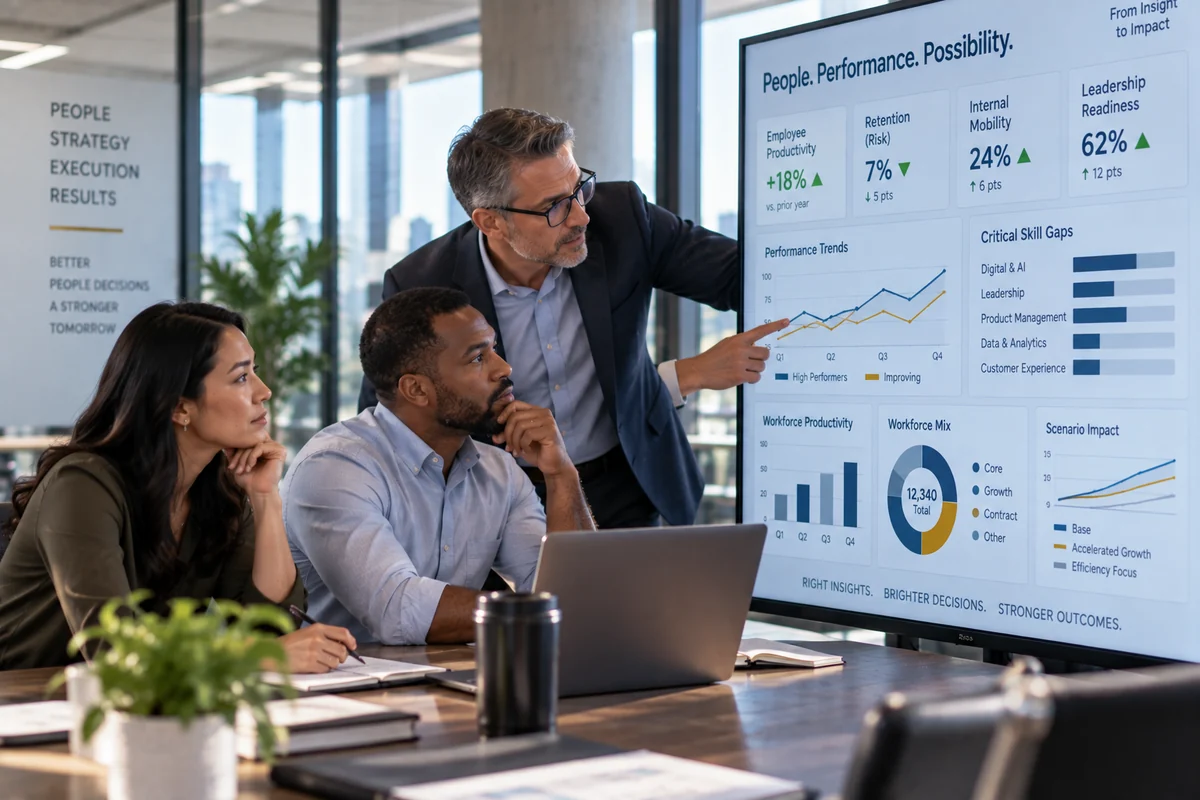
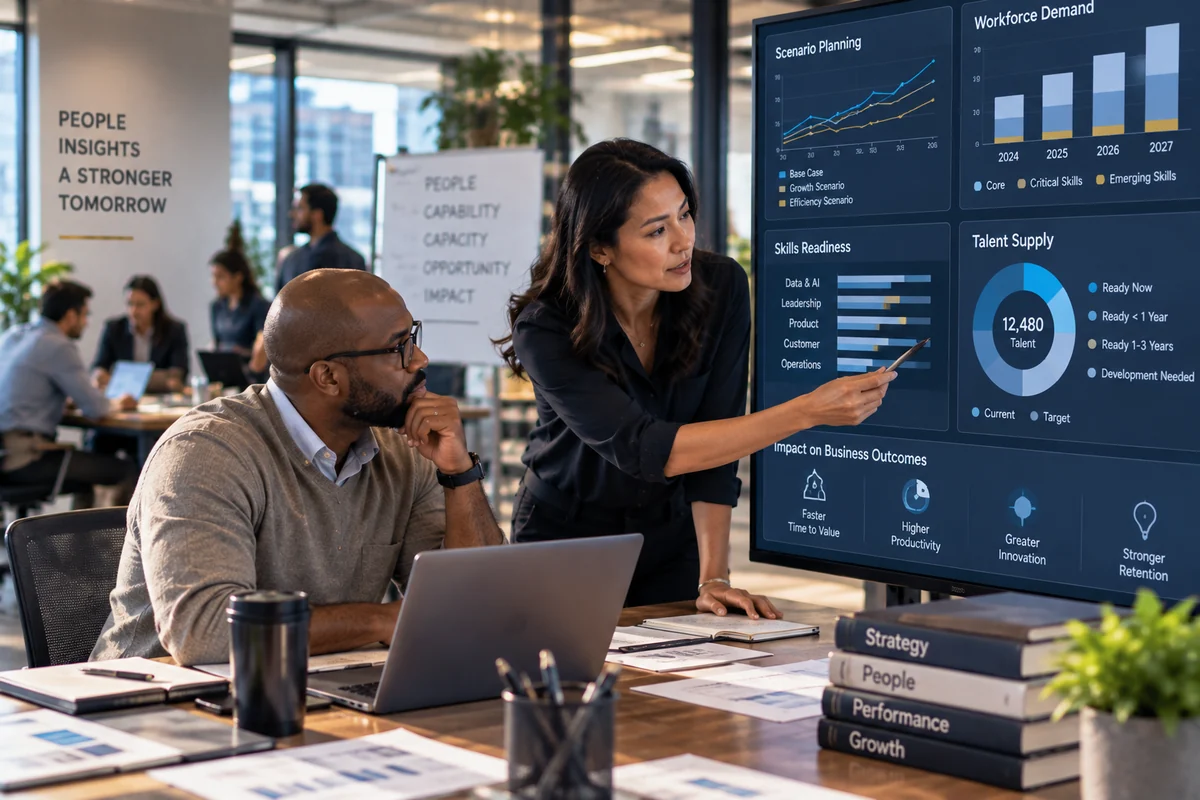
Most organizations are considerably better at measuring workforce outcomes than at sensing the conditions that precede them. Executive dashboards can show voluntary turnover, retirement eligibility, succession coverage, vacancies, engagement, internal mobility, learning activity, and productivity with increasing accuracy. Those measures matter. They establish whether intended outcomes are occurring and reveal where the organization is already experiencing pressure. But many are lagging indicators: they become most visible after a decision has been made, a capability has eroded, a pipeline has weakened, or an employee has already left.
Workforce Intelligence creates greater strategic value when it complements those outcomes with earlier evidence about changing organizational conditions. Leadership depth, internal mobility, workload concentration, manager effectiveness, knowledge distribution, decision friction, development velocity, role dependency, and critical-skill concentration can all change before a traditional workforce event becomes visible. None of these conditions predicts a specific future with certainty. Their value lies in showing whether the organization is becoming more or less vulnerable while leadership still has meaningful options.
That distinction shifts the executive objective from prediction to preparedness. The goal is not to forecast every resignation, retirement, leadership vacancy, or capability shortage. It is to recognize patterns that indicate increasing organizational exposure, test what those patterns mean in context, and strengthen the conditions that determine whether disruption becomes consequential. A workforce risk capability should therefore help leaders answer two questions at the same time: What is becoming more likely, and how prepared is the organization if it occurs?
This is an organizational effectiveness problem as much as a talent problem. Talent risks are shaped by the interaction of leadership, organizational design, capability, workload, mobility, knowledge flow, management practice, and strategic demand. A weak succession bench may reflect more than succession planning. Rising retention pressure may reflect more than employee sentiment. A critical-skill shortage may reflect more than recruiting. When leaders treat the visible event as the entire problem, they can miss the organizational system that made the event more damaging or more likely.
The most useful Workforce Intelligence therefore does more than describe workforce risk after the fact. It helps leadership detect changing conditions early enough to preserve choice, build resilience, and reduce the probability that emerging vulnerabilities become strategic constraints.
Why Talent Risk Rarely Appears Overnight
A respected leader resigns with little notice. A technical expert retires earlier than expected. A succession slate proves too thin when an executive departs. A transformation slows because an essential capability cannot be staffed at the required scale. These events feel sudden because the trigger is visible and the operating consequence is immediate. Yet the event itself may be only the final stage of a much longer progression.
Before a succession gap becomes urgent, high-potential employees may have spent years receiving limited cross-functional exposure. Internal mobility may have slowed. Managers may have protected strong performers rather than releasing them for developmental roles. Leadership development may have remained disconnected from future business requirements. Strategic roles may have changed faster than the criteria used to define readiness. By the time the vacancy appears, the organization is not discovering a new problem. It is discovering the accumulated consequence of earlier conditions.
Capability risk develops similarly. An organization may first experience the problem when a major initiative cannot find enough qualified people, but the vulnerability may have been building through concentrated expertise, weak knowledge transfer, slow development, narrow career paths, delayed workforce planning, or growing dependence on a small number of individuals. Each condition may look manageable in isolation. Together they can reduce organizational resilience long before a dashboard labels the situation a capability gap.
This is why talent risk should not be treated as a collection of isolated HR events. The event matters, but the event is also evidence. It should prompt leaders to ask what underlying conditions made the organization vulnerable, where else similar patterns exist, and whether the same mechanisms could create future risk in other parts of the enterprise. That systems view turns disruption into organizational learning rather than merely incident response.
A useful risk discipline therefore distinguishes the visible event from the conditions that precede it. The visible event creates urgency. The underlying conditions create leverage. Leadership has the greatest ability to influence the trajectory while those conditions are still forming, before the organization becomes dependent on a narrow set of recovery options.
Leading Indicators Expand the Window for Action
Lagging indicators are not inferior measures. They answer an essential question: What outcome actually occurred? Turnover, vacancy rates, succession coverage, time to fill, performance outcomes, and realized capability gaps help leaders validate whether organizational systems are producing acceptable results. Without lagging evidence, leaders can mistake activity or intention for effectiveness.
Leading indicators serve a different purpose. They provide earlier evidence about conditions that may influence future outcomes. A leading indicator does not need to guarantee that a particular event will occur to be useful. It needs to be meaningfully connected to a decision, interpretable in context, and early enough to expand the range of actions available to leadership. This is consistent with the broader use of leading indicators in risk disciplines, where their value lies in proactive visibility rather than certainty.
Internal mobility illustrates the difference. A decline in cross-functional movement does not independently prove that succession risk will increase. But if mobility declines while leadership roles are becoming more complex, development experiences are narrowing, successor depth is weakening, and strategic growth requires broader enterprise experience, the combined pattern deserves attention. The value does not come from labeling mobility as a universal predictor. It comes from understanding what the pattern means for this organization's future leadership requirements.
The same reasoning applies to workload, knowledge concentration, manager effectiveness, capability development, and organizational complexity. A single measure can be noisy or ambiguous. Multiple indicators moving together can provide a stronger signal that the organizational system is changing. This is why mature Workforce Intelligence should avoid treating leading indicators as deterministic scores. The objective is not to manufacture certainty from imperfect evidence. It is to improve the quality and timing of executive attention.
A practical distinction is therefore useful. Lagging indicators confirm outcomes. Leading indicators reveal changing conditions. Context determines significance. Triangulated evidence strengthens confidence. Leadership judgment determines what action is proportionate to the risk. Used together, these elements create a more disciplined sensing capability than either historical reporting or predictive modeling alone.
From Event Risk to Organizational Exposure
The most consequential talent risks are rarely defined only by the probability that an event will occur. They are defined by the interaction between the event and the organization's exposure to it. Two companies can face the same probability that a senior engineer will leave and experience radically different consequences. One may have distributed knowledge, documented systems, multiple successors, external talent options, and sufficient capacity to absorb the transition. The other may depend on one person for critical customer, technical, or operating knowledge. The event is similar. The organizational exposure is not.
This distinction matters because leaders often focus risk discussions on who might leave, which role might become vacant, or which capability may become scarce. Those questions can be useful, but they can also encourage a narrow prediction mindset. A stronger question is: What would make this event strategically damaging if it occurred? That shifts attention toward knowledge concentration, successor depth, role criticality, transferability, capacity, interdependencies, time to recovery, and alternative sources of capability.
The same logic applies beyond retention. A capability shortage becomes more serious when the capability is central to strategy, demand is increasing, development lead time is long, external supply is constrained, and adjacent teams cannot absorb the work. A leadership vacancy becomes more serious when decision authority is concentrated, successor experience is narrow, and the operating model depends heavily on the incumbent. Risk is therefore not simply the presence of a vulnerability. It is the relationship among strategic importance, likelihood, organizational dependence, and readiness to respond.
This is where talent risk becomes directly connected to organizational effectiveness. The organization's design can either amplify or absorb workforce disruption. Strong organizations do not eliminate uncertainty. They reduce unnecessary fragility by distributing knowledge, developing options, clarifying decision authority, building bench strength, maintaining capability pathways, and designing work so that a single event is less likely to become an enterprise constraint.
A Workforce Risk Sensing Logic
Rather than treating talent risk as a proprietary score or a universal formula, leaders can use a simple sensing logic to structure inquiry. First, identify the business outcome or strategic capability that would be materially affected. Second, examine the organizational conditions that support or threaten that outcome. Third, look for behavioral and workforce signals suggesting those conditions are changing. Fourth, assess whether capability, capacity, or resilience is beginning to weaken. Finally, determine whether the combined evidence is strong enough to justify action, deeper investigation, or continued monitoring.
The sequence matters because it prevents a common analytical error: beginning with an available metric and searching for a risk story. A decline in engagement, for example, should not automatically be translated into retention risk. A lower mobility rate should not automatically be translated into succession weakness. A rising workload measure should not automatically be labeled burnout risk. Each indicator should be interpreted against strategic requirements, organizational context, historical patterns, qualitative evidence, and other relevant signals.
This also establishes an important evidence boundary. Workforce Intelligence can identify patterns, pressure points, and plausible risk hypotheses. It should not manufacture causal conclusions that the evidence cannot support. If the signal is consequential, leadership may need additional evidence from stakeholder interviews, workflow analysis, talent reviews, business outcomes, role architecture, or operational data before deciding why the pattern exists and what intervention is appropriate.
The practical advantage of this approach is not perfect prediction. It is earlier and more disciplined choice. When leaders identify an emerging vulnerability while the system can still be changed, they may have multiple options: develop internal capability, redesign work, redistribute decision authority, accelerate knowledge transfer, strengthen succession, adjust strategic sequencing, acquire external capability, or reduce dependence on a fragile role. As risk progresses, those options tend to become fewer, more expensive, and more disruptive.
What Great Organizations Do Differently
Great organizations do not assume that a sophisticated predictive model can substitute for understanding the system. They combine workforce analytics with strategic context and organizational evidence. A risk signal is not treated as meaningful simply because an algorithm can calculate it. Leaders ask what the signal represents, what other evidence supports it, whether the relationship is plausible in the current context, and whether the organization can act differently because the signal was identified.
They also examine relationships across organizational systems. Succession, retention, mobility, capability development, workforce planning, organization design, and employee experience are not treated as unrelated reporting streams. A decline in mobility may matter because it affects breadth of experience. That may reduce successor readiness. Thin successor depth may increase dependence on a small number of leaders. That dependence may increase execution risk during growth or transformation. The insight comes from the relationship, not from any single metric.
Great organizations integrate workforce risk into business decisions before those decisions are finalized. Expansion, acquisitions, automation, restructuring, operating-model changes, and transformation all create assumptions about capability, capacity, leadership, and workforce resilience. If those assumptions are not tested until execution is underway, talent risk becomes a downstream recovery problem. When workforce evidence enters strategic planning earlier, leaders can change sequencing, investment, design, or ambition while options remain open.
They distinguish prevention from preparedness. Some risks can be reduced by changing the conditions that make them more likely. Others cannot be prevented with confidence. A key employee may still resign. A labor market may still tighten. A new technology may still change capability demand faster than expected. Mature organizations therefore work on both sides of the problem: reducing avoidable vulnerability and increasing the organization's ability to absorb disruption when it occurs.
Finally, great organizations learn from realized risk. Significant workforce events are reviewed not only to explain what happened but to improve future sensing. Leaders ask which signals were visible, which were ignored, which proved misleading, and which organizational dependencies magnified the consequence. This creates a feedback loop through which the organization's risk logic becomes more accurate over time without pretending that uncertainty can be eliminated.
These questions help leadership test whether Workforce Intelligence is merely documenting workforce outcomes or strengthening the organization's ability to recognize and absorb emerging risk.
1. Which organizational conditions concern us even though no visible workforce problem has appeared yet?
Executives should identify conditions that could become strategically important if they continue moving in the same direction. Examples may include declining cross-functional movement, increasing dependence on a small number of experts, weakening successor depth, sustained workload imbalance, slowing capability development, or growing managerial span and decision friction. The purpose is not to label every unfavorable trend a risk. It is to identify conditions that deserve attention before the business is forced to respond under pressure.
2. Are we assessing the probability of an event, or the organization's exposure if the event occurs?
Risk discussions often concentrate on who may leave or where a vacancy may emerge. Executives should also examine how damaging the event would be and why. What knowledge is concentrated? How quickly could capability be replaced or redeployed? Is decision authority overly dependent on one role? Is successor depth credible? How much capacity exists to absorb disruption? Exposure frequently provides a more actionable leadership agenda than prediction alone.
3. Are we interpreting individual indicators, or triangulating patterns across the organization?
A leading indicator rarely carries enough meaning by itself. Leadership should ask whether multiple forms of evidence point toward the same vulnerability and whether the pattern is coherent with business context. Quantitative measures, qualitative evidence, workforce trends, operational signals, and leadership observations should reinforce or challenge one another. When the evidence conflicts, the appropriate response is investigation, not forced certainty.
4. Do workforce risks enter strategic decisions early enough to change the decision?
If capability, succession, mobility, capacity, or critical-role risk is discussed only after a strategy has been approved, Workforce Intelligence is operating too late. Executives should test the workforce assumptions inside major strategic choices while those choices can still be changed. The strongest workforce insight is not merely one that explains execution difficulty. It is one that improves the design of the decision before execution begins.
5. If the event we fear happens tomorrow, how resilient is the organization today?
No analytical system can predict every resignation, retirement, market change, or capability disruption. Executives should therefore ask whether the organization can continue executing if an important assumption fails. Resilience depends on more than staffing. It reflects knowledge distribution, decision clarity, successor depth, capability transferability, adaptable work design, leadership capacity, and the availability of credible alternatives. Preparedness is the ultimate test of whether talent risk management is strengthening the organization rather than merely forecasting it.
Organizations cannot eliminate workforce uncertainty, and they should be cautious about systems that imply they can. Predictive analytics can identify patterns and estimate probabilities, but organizational life remains shaped by changing markets, individual choices, strategic decisions, technology, leadership behavior, and interactions that no model can capture perfectly. The executive responsibility is not to achieve certainty. It is to improve the organization's ability to recognize meaningful change and respond before vulnerability becomes constraint.
That requires a systems view of talent risk. A resignation is an event. The strategic risk may be concentrated knowledge, absent successor depth, fragile work design, or insufficient capacity to absorb the loss. A capability shortage is an outcome. The strategic risk may have developed through years of weak mobility, slow development, misaligned workforce planning, or changing business requirements. By examining the conditions beneath the event, leaders move from reacting to symptoms toward strengthening the organizational system.
Workforce Intelligence contributes by creating earlier, evidence-based visibility into those conditions. Leading indicators can extend the window for action, but only when they are interpreted in context and combined with other evidence. Their purpose is not to assign deterministic labels to people or teams. It is to help leaders recognize where organizational exposure is increasing, where assumptions need to be tested, and where the cost of waiting may exceed the cost of acting.
The most mature risk capability therefore balances two ambitions: reduce the likelihood of avoidable disruption and increase resilience to the disruption that cannot be predicted or prevented. That is a more durable objective than perfect forecasting because it improves the organization even when the predicted event never occurs.
Talent risk is managed best when leaders can see vulnerability while choices still exist. The purpose of Workforce Intelligence is not to predict every workforce disruption. It is to identify changing organizational conditions early enough that leadership can strengthen the system before uncertainty becomes a strategic constraint.
Supporting Research
- Boudreau, J. W., & Ramstad, P. M. (2007). Beyond HR: The new science of human capital. Harvard Business School Press.
- Cappelli, P. (2008). Talent on demand: Managing talent in an age of uncertainty. Harvard Business Press.
- Hausknecht, J. P. (2017). Collective turnover. Annual Review of Organizational Psychology and Organizational Behavior, 4, 527-544.
- Hausknecht, J. P., & Trevor, C. O. (2011). Collective turnover at the group, unit, and organizational levels: Evidence, issues, and implications. Journal of Management, 37(1), 352-388.
- Hom, P. W., Lee, T. W., Shaw, J. D., & Hausknecht, J. P. (2017). One hundred years of employee turnover theory and research. Journal of Applied Psychology, 102(3), 530-545.
- Marler, J. H., & Boudreau, J. W. (2017). An evidence-based review of HR analytics. The International Journal of Human Resource Management, 28(1), 3-26.
- Rasmussen, T., & Ulrich, D. (2015). Learning from practice: How HR analytics avoids being a management fad. Organizational Dynamics, 44(3), 236-242.
- Van den Heuvel, S., & Bondarouk, T. (2017). The rise (and fall?) of HR analytics: A study into the future application, value, structure, and system support. Journal of Organizational Effectiveness: People and Performance, 4(2), 127-148.