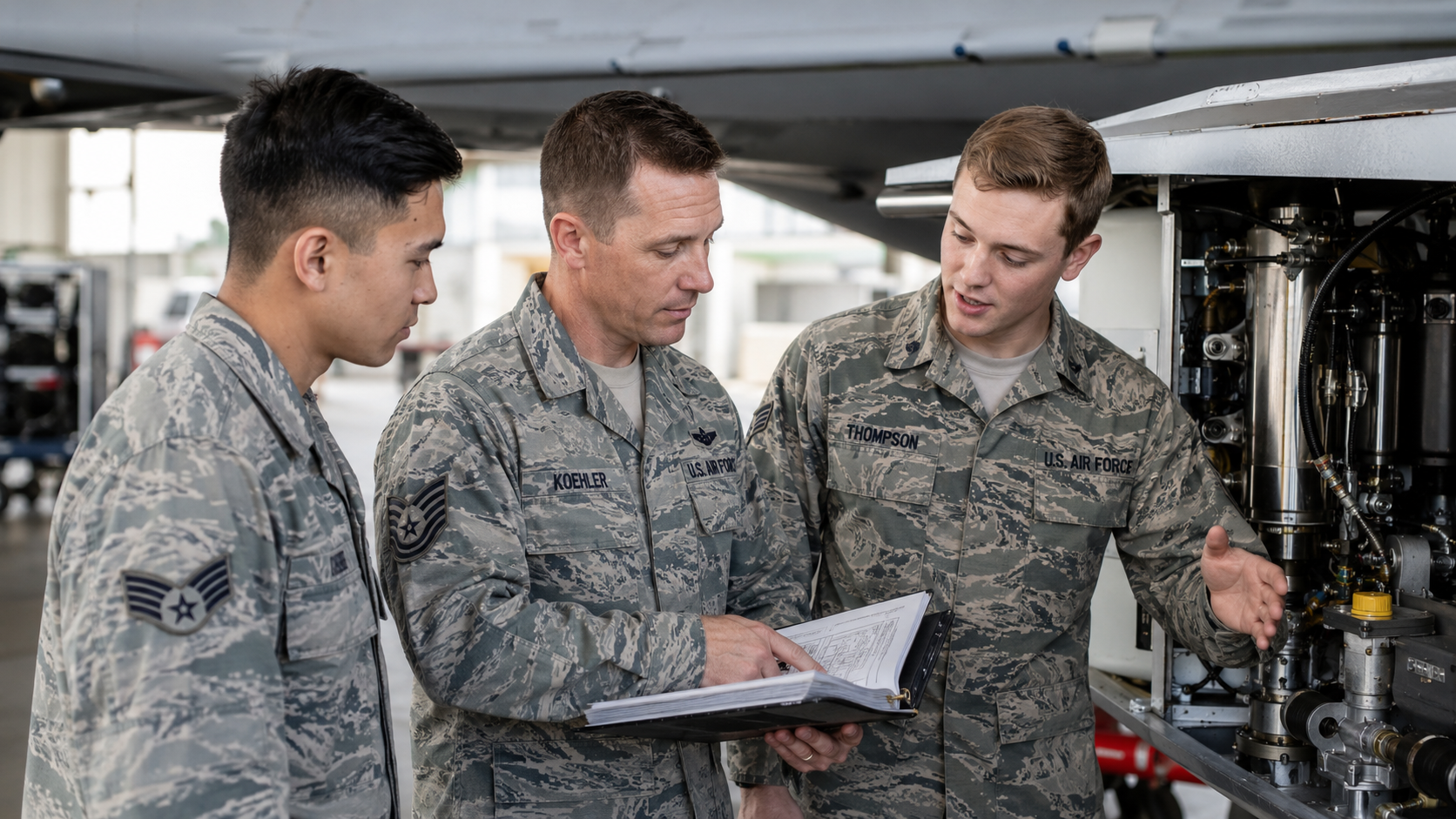

Military organizations routinely operate under conditions that many businesses would consider extraordinarily difficult. They execute complex missions across multiple locations, integrate specialists representing different professions, adapt continuously to changing conditions, and sustain performance despite uncertainty, resource constraints, and organizational change. Their effectiveness cannot be explained by the presence of extraordinary individuals alone. It also depends on the systems, standards, development practices, and operating discipline through which individual capability becomes organizational capability.
This distinction is more significant than it first appears. Executive leadership discussions frequently emphasize vision, communication, emotional intelligence, strategic thinking, and decision making. Decades of leadership research have significantly improved our understanding of how individual leaders influence organizational performance, employee engagement, and organizational culture. These contributions remain essential because organizations ultimately depend upon effective leadership at every level. Yet leadership alone rarely explains why one organization consistently executes while another struggles despite having talented people, capable managers, and a well-defined strategy.
Research across organizational learning, high-reliability organizing, culture, and leadership reinforces a related idea: sustained performance depends not only on individual leaders, but also on the organizational conditions through which people coordinate, learn, make decisions, and execute. Leadership matters, but its effects are strengthened or constrained by the systems through which the organization operates.
During my years serving in the United States Air Force, I experienced this principle repeatedly. The lessons that proved most valuable were not uniquely military. They were organizational. I learned that extraordinary execution depends upon remarkable clarity. That accountability becomes possible only when authority, expectations, and purpose align. That organizations become more adaptable when leaders deliberately develop capability throughout the enterprise rather than concentrating expertise within a small number of individuals. Most importantly, I learned that sustainable organizational performance is never created by leadership alone. It emerges from the disciplined systems leaders intentionally build.
Those observations closely align with decades of organizational research, yet they also suggest an important distinction that receives far less attention in executive leadership discussions. Leadership creates direction. Organizational leadership builds capability. Direction helps people understand where to move and why. Capability determines whether the organization can continue performing as conditions change, leaders rotate, priorities evolve, or unexpected challenges emerge.
The strongest organizations are therefore not sustained by extraordinary leaders alone. They are strengthened by leaders who intentionally build organizations capable of succeeding beyond any single individual. That distinction changes how leadership itself should be understood.
Leadership Is About More Than Leading People
Leadership is often described through the behaviors of exceptional individuals. Organizations invest heavily in helping leaders become more strategic, communicate more effectively, inspire others, navigate change, coach employees, and make better decisions. These capabilities are important because organizations depend on leaders who can provide direction, build trust, and guide people through complex environments. Yet one of the most important leadership questions receives far less attention: what happens when the leader is no longer in the room?
Organizations that depend heavily on the presence, personality, or expertise of individual leaders can perform well while those leaders remain actively involved. Decisions continue moving because experienced leaders intervene. Collaboration occurs because respected individuals personally resolve conflict. Standards remain high because strong managers continually reinforce expectations. Performance may appear healthy, but much of that performance can depend on constant leadership intervention. Over time, this creates hidden organizational dependencies. Decisions wait for approval, knowledge becomes concentrated within a few experienced individuals, cross-functional coordination depends on personal relationships, and leadership transitions become disruptive because institutional knowledge leaves with the individual rather than remaining embedded in the organization.
Throughout my experience in the United States Air Force, leadership was never viewed simply as directing people toward the next objective. Leaders established priorities, communicated expectations, and made difficult decisions, but they were also expected to leave behind organizations that remained effective after they departed. Every assignment was temporary and every leadership position would eventually change. Organizational effectiveness therefore depended not only on individual leadership quality, but on the capability leaders deliberately developed throughout the organization.
That perspective changes the purpose of leadership. Instead of asking only how leaders become more effective personally, organizational leadership asks how leaders make the organization more capable because they were there. The answer is rarely charisma, authority, or expertise alone. It is found in the systems leaders intentionally create: mission clarity, decision authority, shared standards, leadership development, operational discipline, knowledge transfer, and continuous learning. These elements reduce unnecessary dependence on any one leader and increase the organization's ability to sustain performance through leadership transitions and changing conditions.
Mission Creates Alignment, Not Motivation
One of the most enduring misconceptions about organizational leadership is that the primary purpose of a mission statement is to inspire people. Organizations devote significant effort to crafting statements that communicate purpose, values, and aspirations, hoping they will motivate employees and strengthen culture. Inspiration has value, but reducing mission to motivation overlooks its more important organizational role: mission creates alignment by giving people a shared context for priorities, tradeoffs, and decisions.
A mission statement and mission clarity are not the same condition. Most organizations can display their mission on a website, print it in employee materials, or reference it during leadership meetings. Yet if employees at different levels consistently interpret priorities differently, resolve competing demands inconsistently, or pursue conflicting objectives despite sharing the same mission statement, the organization may possess mission awareness without possessing mission clarity. Mission awareness tells people what the organization hopes to accomplish. Mission clarity gives people enough shared context to interpret what matters when conditions change and additional direction is not immediately available.
That distinction became evident throughout my experience in the United States Air Force. Missions often involved changing conditions, incomplete information, and circumstances that could not be fully anticipated in advance. Under those conditions, organizations cannot depend on leaders issuing detailed instructions for every situation. Execution depends on people understanding the larger purpose well enough to adapt their actions while remaining aligned with the intended outcome. The same principle applies to business, where senior leaders cannot and should not make every important decision personally.
Mission clarity can reduce unnecessary escalation because people possess a clearer basis for judgment. Managers spend less time repeatedly clarifying priorities, and cross-functional teams can evaluate competing alternatives against shared organizational objectives instead of relying only on functional preferences. When priorities are not sufficiently shared, local optimization can begin competing with enterprise performance. Individuals may work hard, departments may pursue legitimate objectives, and managers may optimize within their own functions, yet those efforts can still diverge. Conditions that appear to be communication problems may therefore be rooted in insufficient mission clarity.
Mission is not a substitute for governance, structure, or leadership judgment, but it functions as part of the organization's operating system. It provides context for how priorities are interpreted, how decisions are evaluated, and how work remains aligned when leaders are not present to provide continuous direction. That is what allows thousands of independent decisions to move in a coherent direction without requiring thousands of separate approvals.
Disciplined Execution Is an Organizational Capability
Execution is often described as a leadership responsibility, yet organizations execute through systems rather than individual effort alone. Leaders establish direction, communicate priorities, allocate resources, and remove obstacles, but the consistent delivery of performance depends on whether the organization itself has developed the capability to execute repeatedly under changing conditions. This becomes increasingly important as organizations grow and informal coordination becomes harder to sustain.
Many organizations respond to growth and inconsistency by adding more meetings, approvals, reports, governance, and procedures. Each addition may address an immediate concern, but additional control does not necessarily create disciplined execution. Bureaucratic control relies primarily on oversight. Disciplined execution relies on shared standards, clear responsibilities, developed capability, understood decision authority, and repeatable operating practices that allow people to act with consistency without continual intervention.
This was one of the most valuable organizational lessons I carried from the United States Air Force into consulting. Operational discipline was not achieved through constant supervision alone. It was built through clear standards, continuous training, deliberate preparation, shared expectations, and structured learning after performance. People could be trusted with responsibility because the organization had invested in capability before asking them to perform under demanding conditions.
The same principle transfers to business. Organizations frequently expect consistent execution while providing inconsistent operating systems. Priorities change without sufficient explanation, decision authority remains ambiguous, processes vary across departments, performance expectations differ by manager, and lessons learned remain isolated within teams. When execution varies, leaders may attribute the inconsistency to people even when the operating environment is contributing materially to the variation. Mature organizations therefore examine both individual accountability and the conditions under which performance occurred.
When execution deteriorates, leaders should ask whether the mission was clear, priorities were aligned, capability was sufficient, authority was understood, governance supported the work, and expectations were consistent. These questions do not reduce individual accountability. They make it more meaningful by establishing whether the organization created reasonable conditions for successful performance. Disciplined execution is therefore evidence not only of individual discipline, but of how effectively leaders have designed and reinforced the organization around the work that must be performed.
Great Leaders Build More Leaders, Not More Followers
Leadership is often measured by the influence an individual leader has over the people they lead. Organizations celebrate leaders who inspire confidence, motivate teams, navigate uncertainty, and consistently deliver results. These qualities matter, but leadership measured only by personal effectiveness creates an organizational risk: the organization can gradually become dependent on the continued presence of the leader.
At first, that dependence may appear beneficial. Decisions move quickly because experienced leaders possess deep institutional knowledge. Problems are resolved efficiently because trusted leaders know who to involve and how the organization operates. Teams perform well because they have confidence in the leader's judgment. Over time, however, important decisions may begin waiting for specific leaders, knowledge can become concentrated within a handful of individuals, and emerging leaders can receive fewer opportunities to develop because established leaders continue solving the organization's most difficult problems themselves. The organization may continue to perform well while becoming less resilient.
One of the most enduring lessons I carried from the United States Air Force was that leadership positions were temporary. Assignments changed, people moved, promotions occurred, and retirements happened. The expectation was not that one leader would remain indefinitely to sustain performance. The expectation was that the organization would continue succeeding after the leader departed. That changes the leadership question from “How can I become more effective?” to “How can this organization become more capable because I was here?”
That distinction has direct implications for leadership development. Programs, assessments, coaching, and succession planning can improve individual capability, but their organizational value depends on what happens after development occurs. Newly developed leaders who return to environments with unclear authority, inconsistent governance, conflicting priorities, or few opportunities to exercise new capabilities may improve personally without materially strengthening the organization. Leadership development creates greater value when it expands the number of people capable of exercising judgment, taking responsibility, and sustaining performance.
Leadership develops through responsibility, progressively more complex assignments, meaningful decisions, constructive feedback, learning from failure, and mentoring that transfers judgment rather than only knowledge. Experienced leaders strengthen the organization when they intentionally create opportunities for others to succeed without constant supervision. They ask who can make a decision without them, who is ready for greater responsibility, what knowledge must be transferred, and which capabilities must remain in the organization after they leave. This may be less efficient in the short term than solving every difficult problem personally, but over time it distributes judgment, knowledge, and leadership capacity throughout the organization.
Leadership should therefore be evaluated not only by the results achieved during a leader's tenure, but also by whether the organization becomes more capable after that leader has moved on. Organizations built around individuals eventually become limited by those individuals. Organizations that deliberately distribute capability are better positioned to sustain performance through leadership transitions and changing conditions.
Extraordinary Organizations Are Built Intentionally
One of the greatest misconceptions about organizational performance is the belief that exceptional organizations emerge naturally when enough talented people are brought together. Organizations invest heavily in recruiting experienced leaders, attracting high-performing employees, acquiring new technologies, and developing innovative strategies. Each investment is important, yet talent alone rarely produces sustained organizational excellence. Extraordinary organizations are not created simply by assembling talented people. They are built through repeated leadership choices that strengthen the conditions for performance over time.
Building an organization requires leaders to think beyond today's operational challenges and consider how today's decisions will influence the organization's ability to execute years from now. Decisions about leadership development, governance, decision authority, organizational design, performance management, communication, and culture can either strengthen or weaken future capability. Those effects accumulate gradually through everyday decisions about standards, authority, learning, development, and coordination. Rarely does an organization become exceptionally capable because of one transformational initiative or one extraordinary leader. Capability develops through repeated leadership decisions that reinforce one another over time. Standards become habits, habits influence culture, and culture can reinforce the organizational capability required for consistent performance.
This cumulative perspective helps explain why organizational excellence can appear deceptively ordinary from the outside. People understand what matters. Decisions are made with confidence. Leaders trust their teams because those teams have demonstrated sound judgment. Collaboration occurs without excessive coordination. Problems are addressed before they become crises, and learning becomes part of everyday operations rather than an activity reserved for annual planning. These outcomes are rarely the product of a single initiative. They more often reflect sustained organizational development and reinforcement.
One lesson from the United States Air Force continues to influence how I think about organizations today: preparation began long before demanding performance was required. Organizations did not wait until conditions became difficult before developing leaders, clarifying expectations, strengthening teamwork, or refining operating practices. Capability was built continuously because uncertainty could not be predicted. When challenging conditions arrived, organizations depended on habits, relationships, trust, and systems that had already been developed.
The same principle applies to business. Organizations rarely have the luxury of building capability after disruption begins. Market conditions change, customer expectations evolve, technologies reshape industries, economic conditions fluctuate, and leadership transitions occur. Organizations that respond effectively are often those that invested in organizational capability before those challenges appeared. Organizational leadership should therefore be viewed as a long-term discipline rather than a series of short-term management decisions.
A useful leadership test is whether consequential decisions leave the organization more capable than it was before. Governance improvements should make future decisions clearer. Development opportunities should increase organizational capacity rather than only individual competence. Leadership transitions should strengthen continuity rather than create instability, and lessons learned should become organizational knowledge rather than remain personal experience. Over time, these decisions compound into organizational habits and capabilities that make the organization more resilient, adaptable, and able to execute under demanding conditions.
This may be the most enduring lesson my Air Force experience taught me. Extraordinary organizations are not defined only by extraordinary moments. They are also defined by the preparation that makes strong performance repeatable when difficult moments arrive. Much of that preparation is difficult to see from outside the organization. Customers see products, employees experience culture, executives review performance, and competitors observe results. What they seldom see are the years of disciplined leadership, capability development, and organizational design that produced those outcomes.
Leadership, therefore, should not be evaluated only by the decisions leaders make today. It should also be evaluated by the capability those decisions help create for tomorrow. The objective extends beyond achieving results during a leader's tenure. It includes building an organization capable of continuing to perform after today's leaders have moved on.
Building an extraordinary organization is not the result of one leadership decision or one successful initiative. It is the cumulative outcome of thousands of decisions that either strengthen or weaken organizational capability over time. Before launching a leadership initiative, restructuring a team, or addressing organizational performance challenges, executive teams should challenge themselves with five questions.
1. Are we developing leaders, or are we developing organizational capability?
Leadership development should never end with improving the effectiveness of individual leaders. The greater objective is to ensure that every investment in leadership leaves the organization itself stronger, more resilient, and more capable of sustaining performance over time.
2. Does our mission create alignment or simply communicate purpose?
Mission statements have little value if they remain inspirational language disconnected from daily decisions. Leaders should ask whether employees throughout the organization understand organizational priorities well enough to make consistent decisions without continual direction from senior leadership.
3. Does our operating system make disciplined execution possible?
Organizations often attribute inconsistent execution to individual performance when the underlying issue is unclear priorities, ambiguous decision authority, inconsistent governance, or poorly designed operating processes. Leaders should evaluate whether the organization has created the conditions that make successful execution repeatable.
4. Are we creating dependency on individual leaders or distributing organizational capability?
Healthy organizations continually transfer knowledge, develop future leaders, clarify responsibilities, and build systems that enable success beyond any single individual. If performance depends on the continued presence of a few key leaders, organizational capability has not yet been fully developed.
5. If our senior leadership team changed tomorrow, what organizational capabilities would remain?
This may be the most revealing leadership question of all. Leadership transitions should not fundamentally weaken an organization. If critical knowledge, decision making, culture, or execution disappear with individual leaders, those capabilities were never truly embedded within the organization.
These questions are intentionally diagnostic rather than evaluative. Their purpose is not to judge leadership effectiveness, but to help executive teams determine whether they are building organizations that will continue succeeding regardless of who occupies individual leadership positions.
Leadership has traditionally been viewed through the lens of individual influence. Organizations celebrate visionary executives, exceptional communicators, decisive leaders, and those who inspire others to achieve remarkable results. Those qualities remain important because organizations need leaders capable of providing direction during uncertainty and change. Yet extraordinary organizations are rarely sustained through individual leadership alone. They are sustained through the organizational capability leaders intentionally build.
Mission creates alignment, disciplined execution creates consistency, continuous development strengthens future capability, and organizational systems reinforce individual leadership rather than depending entirely on it. Over time, these conditions allow organizations to adapt, learn, and perform through changing circumstances and leadership transitions. The greatest legacy of leadership is therefore not limited to the success achieved during a leader's tenure. It also includes the capability that remains after the leader has moved on.
Leadership creates direction. Organizational leadership builds capability. Extraordinary organizations require both.
Supporting Research
- Argyris, C., & Schön, D. A. (1996). Organizational learning II: Theory, method, and practice. Addison-Wesley.
- Edmondson, A. C. (2019). The fearless organization: Creating psychological safety in the workplace for learning, innovation, and growth. Wiley.
- Garvin, D. A., Edmondson, A. C., & Gino, F. (2008). Is yours a learning organization? Harvard Business Review, 86(3), 109–116.
- Kotter, J. P. (1996). Leading change. Harvard Business School Press.
- Schein, E. H., & Schein, P. A. (2021). Organizational culture and leadership (5th ed.). Wiley.
- Weick, K. E., & Sutcliffe, K. M. (2015). Managing the unexpected: Sustained performance in a complex world (3rd ed.). Wiley.
- Yukl, G. (2013). Leadership in organizations (8th ed.). Pearson.