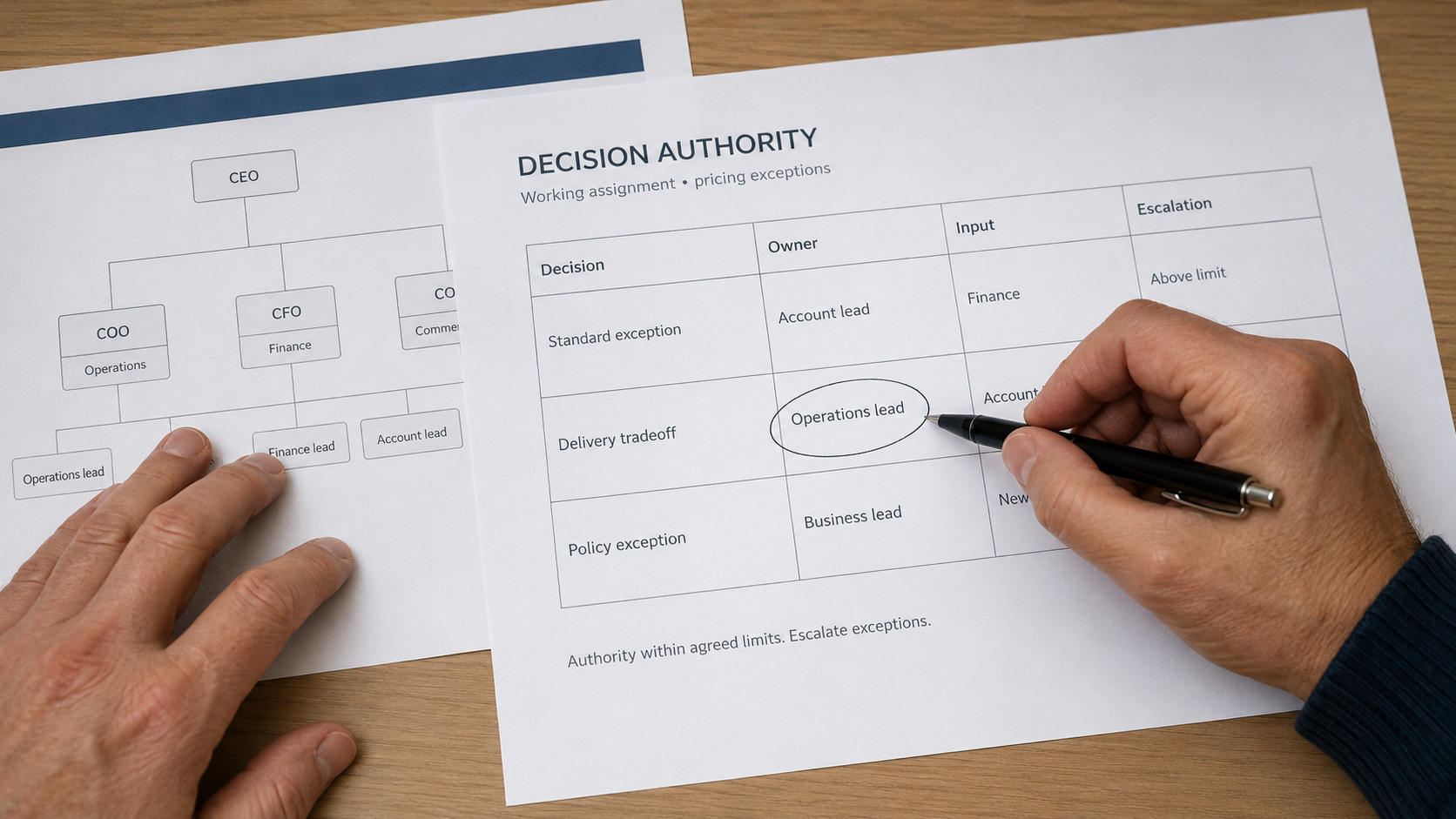

An organization chart can tell leaders a great deal about an organization. It identifies formal reporting relationships, shows how work has been grouped, makes management layers visible, and indicates where authority and accountability have been assigned. For executives trying to understand a complex enterprise quickly, few artifacts communicate formal structure as efficiently.
The problem begins when the chart becomes a substitute for understanding the organization itself.
An organization does not perform because its boxes are arranged logically. Performance emerges because decisions are made, information reaches the people who need it, work moves across organizational boundaries, capabilities are combined, leaders reconcile competing priorities, and employees form relationships that allow the formal structure to operate. Much of that activity never appears on the organization chart.
Consider a customer issue that begins with Sales but requires input from Product, information from Operations, judgment from Finance, contractual interpretation from Legal, and perhaps an executive decision because the issue falls outside established parameters. The organization chart may clearly identify the leader accountable for the customer relationship. It does not reveal the organizational system required to resolve the problem.
This distinction is increasingly important as work becomes more interdependent. Organizational research has long recognized that uncertainty and interdependence increase information-processing and coordination requirements. Galbraith's work on organizational design established that organizations require mechanisms beyond hierarchy alone to process information and coordinate complex work. Research on informal organizational networks similarly demonstrates that important information, expertise, and collaboration frequently move through relationships that formal reporting structures do not reveal.
The implication is not that organization charts have become obsolete. Formal structure remains essential. Organizations need accountability, managerial authority, resource allocation, role clarity, and mechanisms for resolving issues that cannot be addressed through informal coordination.
The more consequential insight is that formal structure represents only one dimension of the organization through which performance is produced.
When leaders overlook that distinction, they can diagnose organizational problems through the structure they can see while the actual constraint exists somewhere else. Slow execution may be attributed to hierarchy when the problem lies in decision authority. Weak collaboration may trigger changes in reporting relationships when incompatible workflows or incentives are responsible. A capability gap may lead to the creation of a new function even though the required capability depends on expertise distributed across several existing functions.
The organization chart can accurately describe where people sit and still provide an incomplete explanation of how the organization works.
TQG's perspective is that leaders need to understand both the formal organization and the performance architecture through which important outcomes are actually produced. The second view does not replace the first. It reveals the decisions, relationships, workflows, capabilities, information, and organizational interfaces that the chart necessarily simplifies.
That changes the executive question. Instead of asking only, "How are we organized?", leaders should also be able to answer, "How does this organization actually produce the outcomes that matter?"
The distance between those two answers often reveals where organizational design needs the most attention.
The Org Chart Solves a Real Problem
The organization chart became influential because hierarchy solves legitimate organizational problems. As enterprises grow, leaders need ways to divide work, coordinate specialization, establish managerial responsibility, allocate resources, and clarify authority. Formal structure provides an essential mechanism for accomplishing those tasks.
Its visual simplicity is one of its greatest strengths. An enterprise containing thousands of employees and millions of interactions can be reduced to a representation leaders can understand in minutes. Functions, business units, leadership roles, reporting lines, and layers become visible at a glance.
That simplification also creates the chart's fundamental limitation.
Most of what makes the organization operate has been intentionally removed.
The chart typically does not show which functions must interact constantly, where important information originates, which decisions require multiple forms of expertise, how long work waits at organizational boundaries, who has become an informal source of influence, which roles possess scarce knowledge, or where employees have created workarounds around formal processes.
Those omissions matter because organizational performance increasingly depends on horizontal coordination across vertically managed structures. A product may be owned within one part of the hierarchy but require Technology, Finance, Sales, Operations, Legal, Procurement, and other functions to bring it to market. A transformation may have a formal sponsor while relying on dozens of capabilities outside that leader's reporting structure.
The chart remains correct.
It is simply answering a narrower question than the one leaders may be asking.
Formal structure answers, "How have authority and accountability been arranged?"
It does not fully answer, "How does performance happen?"
Confusing those questions is where organizational diagnosis begins to weaken.
The Formal Organization and the Performance Architecture
Suppose a company has made customer retention a strategic priority. The organization chart may clearly identify the executive responsible for Customer Success, the teams reporting to that leader, and the business units accountable for commercial outcomes.
That assignment is necessary. Someone should be accountable.
But accountability for the outcome is not the same as production of the outcome.
Retention may depend on product quality, implementation, pricing, service responsiveness, billing accuracy, contract flexibility, customer data, technology reliability, account management, and the organization's ability to resolve exceptions quickly. Those conditions may be controlled by leaders scattered throughout the enterprise.
No single box contains the system that produces retention.
TQG refers to this broader view as Performance Architecture, the organizational configuration through which formal authority, decisions, workflows, capabilities, information, and relationships combine to produce an important outcome.
The concept is intentionally narrower than a complete operating model. Its purpose is diagnostic. Rather than trying to map everything occurring throughout the enterprise, leaders can begin with a consequential outcome and examine what must work for that outcome to occur reliably.
This shift changes the unit of analysis. Instead of asking only which function owns innovation, leaders examine how ideas become decisions, how investment is allocated, how expertise combines, how experimentation is supported, and how successful innovations move into operations. Instead of asking where workforce planning sits, leaders examine how strategy, financial assumptions, operating demand, workforce data, labor-market information, talent capability, and executive decisions combine to produce workforce choices.
The ownership question still matters.
The deeper question is whether the organization can actually produce the outcome the owner is accountable for delivering.
Performance Often Lives Between the Boxes
Traditional organizational design naturally directs attention toward organizational units. Leaders examine functions, teams, roles, spans, layers, and reporting relationships because those components can be identified and assigned accountability.
Important organizational outcomes, however, are frequently produced at the interfaces between those units.
A customer commitment passes from Sales to Operations. A product decision requires Product and Engineering. A workforce investment involves Business Leadership, Finance, and HR. A strategic initiative requires operating leaders and technology teams to make choices together. Each transition creates an interface through which information, authority, expertise, priorities, and accountability have to move.
The quality of those connections can matter as much as the quality of the components themselves.
This idea has support in research on coordination and organizational relationships. Relational coordination research, for example, has examined how shared goals, shared knowledge, mutual respect, and communication among interdependent participants can influence performance, reinforcing the importance of the relationships through which coordinated work occurs. Formal mechanisms matter, but they do not by themselves explain whether interdependent work functions effectively.
This presents a problem for organizational diagnosis because functions are much easier to see than interfaces. A function has a leader, budget, headcount, goals, and performance measures. The relationship between two functions may have none of those things even when millions of dollars of value or significant customer outcomes depend on it.
When the interface fails, leaders can therefore diagnose the components rather than the connection.
Sales may believe Operations is unresponsive. Operations may believe Sales creates commitments without understanding delivery constraints. Finance may believe both groups circumvent necessary controls. Each function can provide a defensible explanation from within its own boundaries.
The underlying organizational problem may not live inside any of them.
It may exist in how the interface was designed.
Perhaps information arrives too late. Perhaps decision authority is unclear. Perhaps the functions are rewarded for incompatible outcomes. Perhaps the workflow contains too many handoffs. Perhaps governance becomes involved only after disagreement has already escalated.
This leads to an important TQG proposition: organizational interfaces are designable parts of the organization, not empty space between boxes.
If important work repeatedly crosses an interface, leaders should understand the outcome it supports, what information must cross it, which decisions occur there, what capabilities need to interact, and how disagreements are resolved.
The formal structure tells leaders what organizational components exist.
The interfaces reveal whether those components can produce performance together.
The White Space Contains Organizational Capacity
The white space between functions does not simply contain relationships. It also contains work.
Employees schedule coordination meetings because a workflow does not integrate activities reliably. They create spreadsheets because systems do not share necessary information. They build informal approval routines because decision ownership is ambiguous. They develop personal relationships to move work through organizational boundaries. They escalate issues to senior leaders because no mechanism lower in the organization consistently resolves them.
Much of this activity never appears on an organization chart.
It still consumes organizational capacity.
This means an organization can appear structurally simple while being operationally difficult to navigate. Four functions on a page may conceal dozens of governance forums, overlapping approvals, multiple systems, repeated handoffs, conflicting goals, and extensive informal coordination.
The reverse can also be true. A relatively complex formal structure may perform effectively because its interfaces, decisions, and workflows are intentionally designed.
Structural simplicity and operational simplicity are therefore not the same condition.
This matters when leaders consider reorganizing. Combining two functions can reduce one formal boundary while leaving the coordination mechanisms that created friction unchanged. Removing a layer can shorten the hierarchy while adding governance to replace coordination previously performed by managers.
If leaders evaluate only the visible structure, they may shift complexity rather than remove it.
The organization becomes different on paper while continuing to spend much of the same capacity navigating itself.
The Organization Has More Than One Structure
One reason the org chart provides an incomplete picture is that organizations contain multiple structures operating simultaneously.
There is a formal reporting structure, which establishes managerial relationships and accountability. There is a decision structure, which determines how authority becomes action. There is a workflow structure, which determines how work moves across roles and functions. There is a capability structure, which reflects where expertise resides and how different forms of expertise combine. There is a relationship structure, which influences who communicates, trusts, advises, and coordinates with whom. There is an information structure, which affects who knows what and when that knowledge becomes available.
These structures overlap, but they rarely align perfectly.
That does not automatically indicate poor design. Organizational requirements are different. Expertise may appropriately remain centralized while decisions drawing on that expertise occur closer to customers. Employees may report through functions while participating in cross-functional product teams. Information may need to move across boundaries that formal authority does not.
The problem begins when leadership assumes alignment simply because the organization chart appears clear.
A role may formally own a decision while actual authority sits somewhere else. A function may formally own a capability while most of the expertise required to produce that capability sits outside it. A documented workflow may appear straightforward while employees rely on relationships and workarounds to move the work forward.
The organization therefore cannot be understood from one structure alone.
Understanding performance requires examining how these different structures intersect around consequential work.
Decision Paths Reveal the Real Distribution of Authority
One of the most revealing ways to examine an organization is to follow an important decision through it.
Consider a pricing exception, capital investment, senior hire, product priority, customer commitment, workforce action, or risk decision. The formal structure may indicate who should own the decision, but the actual path can reveal a different organizational reality.
Who first identifies that a decision is required? Who provides the information? Who must be consulted? Who has influence without formal authority? Who can delay the decision? Who is expected to approve it even though governance does not require approval? Where does the decision escalate, and why?
A company may describe itself as decentralized while consequential decisions consistently migrate upward. A governance forum may officially provide input while functioning behaviorally as an approval body. An executive may hold no formal authority over a decision but be consulted so consistently that employees will not act without that executive's support.
These patterns matter because decision design directly affects organizational speed, capacity, accountability, and risk.
A formal delegation does not necessarily create behavioral delegation. If leaders continue second-guessing decisions, information remains inaccessible, mistakes carry disproportionate consequences, or employees believe senior approval is implicitly expected, the real decision structure will remain more centralized than the organization intends.
The decision path may therefore reveal more about how the organization operates than the reporting line of the individual formally accountable for the choice.
Workflows Reveal the Organization in Motion
Decision paths show how authority moves. Workflows show how work moves.
Following an important workflow can reveal where work waits, where information is lost, where roles overlap, where approvals create genuine value, and where employees compensate for weaknesses in the formal design.
A process may cross the same organizational boundary several times. Multiple functions may perform similar reviews because each has been designed independently. Information may be re-entered because systems do not integrate. A governance forum may become the default mechanism for resolving questions that could have been handled through clearer decision rules.
None of these conditions is necessarily visible in hierarchy.
Yet each can affect performance.
This is especially important because organizations often optimize processes within functions while overlooking what happens when those processes connect. A Finance process may be efficient for Finance, and an Operations process may be efficient for Operations. The combined workflow can still create significant friction if the requirements of one were developed without considering the other.
No individual component appears obviously broken.
The relationship among the components is.
This is the same systems principle that appears repeatedly across organizational effectiveness. Strengthening individual parts does not automatically strengthen the system if the interactions among the parts remain poorly designed.
Capabilities Do Not Live Where Their Labels Sit
Capabilities create a similar challenge.
Organizations often assign accountability for a capability to a function. Talent belongs to HR. Analytics belongs to an analytics team. Technology belongs to IT. Strategy belongs to Strategy.
Assigning ownership is necessary.
But organizational capabilities rarely fit neatly inside those boundaries.
Strategic workforce planning may be formally owned by HR, but producing it requires business strategy, financial assumptions, demand forecasts, workforce data, labor-market intelligence, talent knowledge, and leadership judgment. Customer experience may have a dedicated leader, but the capability depends on functions across the customer journey. Transformation capability may sit within a transformation office, but execution depends on leaders and operating systems across the enterprise.
This creates a useful distinction between capability ownership and capability production.
Ownership answers who is accountable for ensuring that a capability exists.
Capability production asks whether the organization can reliably combine the expertise, information, processes, authority, relationships, and resources required to produce it.
A new organizational box can establish ownership immediately.
It cannot create the capability immediately.
That distinction matters when leaders respond to a capability gap by creating a new team. The organization may gain clearer accountability while leaving the underlying production system largely unchanged.
The new box makes the capability visible.
Whether the capability becomes real depends on everything that connects to it.
Informal Networks Are Evidence About the Formal Organization
Employees do not interact only through formal reporting relationships.
They learn who possesses expertise, who understands a difficult customer, who can navigate a legacy system, who has influence with a senior leader, who can interpret an ambiguous policy, and who can connect two parts of the organization that otherwise struggle to coordinate.
Those relationships form an informal network that can materially influence execution. Organizational network research has shown how important collaboration and information flows can be made visible beyond formal hierarchy.
These networks can create considerable value. They help organizations adapt to circumstances the formal design cannot anticipate.
They can also reveal hidden organizational risk.
If one employee is the primary connection between two critical functions, the organization may have a dependency that no succession plan or org chart makes visible. If employees routinely bypass a formal governance process, the process may not fit the requirements of the work. If difficult decisions repeatedly converge on one executive, the organization may be more centralized than its stated decision model suggests.
The appropriate response is not to eliminate informal organization.
It is to learn from it.
When people repeatedly deviate from formal design, leadership should ask what organizational function the deviation is performing. The workaround may be compensating for a broken workflow, unavailable information, unclear authority, insufficient capability, or a relationship the formal structure never adequately created.
What looks like deviation can therefore be evidence.
The real organization is telling leaders something about the designed organization.
The Organizational Reality Gap
Taken together, these patterns point to a larger condition that leaders need to understand.
TQG describes the Organizational Reality Gap as the meaningful difference between how an organization is designed to operate and how consequential work actually occurs.
Every organization will have some gap. No formal design can anticipate every decision, relationship, customer issue, exception, or operating condition. Employees need discretion, adaptation, and informal collaboration.
The objective is not to eliminate that difference.
The concern arises when the gap becomes sufficiently large or consequential that leaders are making decisions based on an inaccurate understanding of how the organization performs.
Leadership may believe decision authority has been distributed because formal governance says it has, while employees continue escalating choices upward. Executives may believe two functions are integrated because they report to the same leader, while their incentives and workflows remain disconnected. A capability may appear established because accountability has been assigned, while the expertise and operating mechanisms required to produce it remain fragmented.
At that point, leaders risk managing the organization they intended to create rather than the organization employees are actually navigating.
The Organizational Reality Gap provides a different lens for diagnosis. The question is not whether informal behavior conforms perfectly to formal design. The question is whether material differences between design intent and operating reality are enabling performance, compensating for weaknesses, or creating risks that leadership cannot see from formal structure alone.
That distinction is powerful precisely because a gap is not automatically a defect.
Sometimes employees have discovered a more effective operating pattern than the formal organization provides. Sometimes informal adaptation is preserving performance. Sometimes the deviation is the earliest indication that the formal design no longer fits the work.
The gap tells leaders where to investigate.
It should not, by itself, tell them what to change.
The Gap Should Be Diagnosed, Not Automatically Closed
Discovering a difference between formal design and operating reality can create an understandable impulse to enforce the formal system.
That may be precisely the wrong intervention.
Suppose employees consistently bypass an official workflow. Leaders could conclude that the organization needs stronger process discipline. But the workaround may exist because the formal process requires information employees cannot access, includes approvals that add little value, operates too slowly for customer requirements, or assumes a sequence that does not reflect how work actually occurs.
Similarly, a highly connected employee who appears to be working around hierarchy may actually be providing an integration mechanism the formal organization failed to create. Removing the dependency without replacing the function it serves could weaken performance.
This creates a critical diagnostic principle: before correcting a deviation from formal design, understand what organizational function that deviation is performing.
Sometimes the designed organization should be reinforced. Employees may be bypassing a legitimate risk control or creating inconsistent decisions that require greater discipline.
Sometimes the operating organization should be redesigned. A workaround may create risk even though the formal process remains inadequate.
Sometimes the formal organization should change because operating experience has revealed a better way to coordinate work.
The important point is that the difference itself does not provide the answer.
It provides evidence.
That is why leaders need diagnosis before redesign.
What Great Organizations Do Differently
Great organizations use multiple representations of themselves.
They maintain organization charts because formal structure matters, but they do not expect those charts to explain the complete system of performance. For strategically important outcomes, leaders understand the decisions, workflows, capabilities, information requirements, and cross-functional dependencies surrounding formal accountability.
They pay particular attention to interfaces. When two functions struggle to coordinate, they resist the immediate conclusion that one should report to the other. They examine what work crosses the boundary, what information is required, where decision rights sit, whether incentives create conflict, and which capabilities need to interact.
They follow consequential decisions rather than assuming delegated authority is functioning as intended. Repeated escalation and informal approvals are treated as organizational evidence.
They pay attention to workarounds and informal relationships without romanticizing them. Some are healthy adaptations. Others reveal fragile dependencies, broken processes, or missing organizational mechanisms. In either case, the pattern deserves to be understood before leaders intervene.
They also distinguish between capability ownership and capability production. Assigning a leader to an enterprise capability creates accountability, but leaders understand that the capability itself may depend on a much broader organizational system.
Most importantly, great organizations do not attempt to force every aspect of operating reality to match the formal design. They seek sufficient alignment so that formal authority, decisions, workflows, information, capabilities, and relationships collectively support the outcomes the strategy requires.
The objective is not perfect conformity.
It is intentional organizational performance.
1. If we removed the reporting lines from our organization chart, could we still explain how our most important outcomes are produced?
Leaders should be able to describe the decisions, workflows, capabilities, information, and organizational relationships that produce strategically important results. If the explanation begins and ends with the accountable function, leadership may understand ownership better than performance production.
2. Where does our most consequential work repeatedly cross organizational boundaries, and how deliberately have we designed those interfaces?
Critical interfaces should not be treated as organizational white space. Leaders should understand the outcomes they support, the dependencies they create, and the coordination required for them to work.
3. Where are consequential decisions actually occurring compared with where formal authority says they should occur?
Repeated escalation, informal vetoes, executive intervention, and shadow approvals can reveal a decision system that differs significantly from formal governance.
4. Which informal relationships or workarounds would materially disrupt performance if they disappeared tomorrow?
These patterns may reveal critical connectors, hidden capability, weak workflows, information gaps, unclear authority, or organizational dependencies that are not visible in the formal structure.
5. Where might a meaningful Organizational Reality Gap be affecting performance?
The objective is not to identify every deviation from design. Leaders should focus on differences that influence important outcomes and determine whether those differences represent effective adaptation, compensation for a design weakness, or organizational risk.
Together, these questions change organizational diagnosis from an examination of static reporting relationships into an investigation of the system through which work actually becomes performance.
Organization charts matter because organizations need formal authority, accountability, grouping, hierarchy, and managerial responsibility. The mistake is not using them. The mistake is expecting them to explain more than they were designed to show.
A chart can identify the executive accountable for customer experience, but it cannot reveal whether the organizational system can consistently produce a strong customer experience. It can show where decision authority should reside, but it cannot tell leaders whether employees actually exercise that authority. It can show where a capability has been assigned, but it cannot demonstrate that the underlying capability exists.
Those distinctions matter because strategy is not executed by boxes. It is executed through an organizational system in motion, with decisions converting information into action, workflows moving work toward outcomes, relationships coordinating interdependence, capabilities combining expertise and resources, and formal structure creating the authority and boundaries within which much of that activity occurs.
This leads to the design principle at the center of TQG's perspective:
An organization chart maps formal authority. Organizational performance is produced by the system connecting authority, decisions, workflows, capabilities, information, and relationships. Leaders need to understand both.
Once leaders see the organization this way, the white space between boxes stops being empty. Informal networks become evidence about how the organization adapts. Workarounds become potential signals about the fit between formal design and operating reality. Cross-functional interfaces become designable organizational mechanisms rather than unavoidable sources of friction.
Organizational design then becomes more consequential than determining where people report.
It becomes the discipline of understanding and shaping the system through which the organization produces performance.
Supporting Research
- Cross, R., Borgatti, S. P., & Parker, A. (2002). Making invisible work visible: Using social network analysis to support strategic collaboration. California Management Review, 44(2), 25–46.
- Galbraith, J. R. (1974). Organization design: An information processing view. Interfaces, 4(3), 28–36.
- Galbraith, J. R. (2014). Designing organizations: Strategy, structure, and process at the business unit and enterprise levels (3rd ed.). Jossey-Bass.
- Gittell, J. H. (2002). Coordinating mechanisms in care provider groups: Relational coordination as a mediator and input uncertainty as a moderator of performance effects. Management Science, 48(11), 1408–1426.
- Lawrence, P. R., & Lorsch, J. W. (1967). Organization and environment: Managing differentiation and integration. Harvard Business School Press.