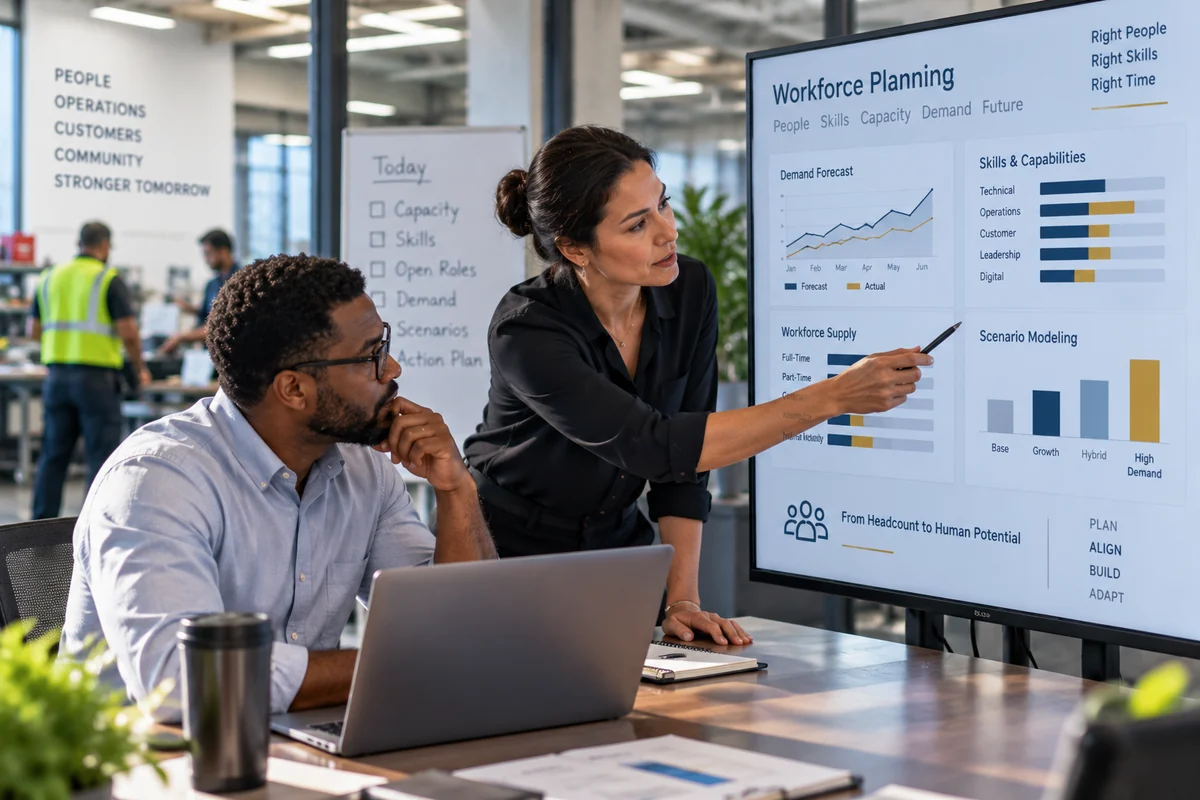

Organizations have become remarkably good at measuring their workforces. Executive dashboards can show headcount, turnover, engagement, hiring activity, internal mobility, succession readiness, performance, workforce demographics, and dozens of other indicators with increasing speed and precision. Investments in HR technology and analytics have given leaders access to more workforce information than ever before. Yet greater visibility does not necessarily produce better decisions. An organization can know considerably more about its workforce while still struggling to determine what that information means for strategy, capability, risk, and future performance.
Part of the problem lies in how workforce information is organized. Most reporting begins with the data an organization possesses. Turnover data becomes a turnover metric. Engagement data becomes an engagement score. Recruiting data becomes measures of vacancies, time to fill, and hiring activity. Succession data becomes coverage and readiness indicators. These measures are useful, but their structure reflects the systems and processes that produce the information. Executives rarely experience the organization in those same categories. They make decisions about growth, investment, transformation, operating models, capability, technology, risk, and execution, each of which may depend on evidence distributed across several workforce and business systems.
Consider an organization reporting voluntary turnover of 12 percent. The number may be accurate, benchmarked, and presented with sophisticated analysis, yet it has no fixed strategic meaning on its own. If departures are concentrated in roles that are readily replaceable or declining in strategic importance, the condition may require little executive attention. If the same turnover is concentrated among experienced leaders or employees possessing scarce capabilities required for future growth, the implications could be substantial. The metric has not changed. What changes is the organizational condition the evidence helps leadership understand.
This distinction becomes even more important when relevant signals appear separately. Increasing turnover among a critical population may be reviewed as a retention issue, declining internal mobility as a talent issue, weakening successor readiness as a succession issue, increasing workload as an operational issue, and longer time to fill as a recruiting issue. Each interpretation may be reasonable. Viewed together, however, the signals may reveal something none of the measures communicates independently: the organization's ability to sustain a strategically important capability may be deteriorating.
That is the shift from HR metrics to Workforce Intelligence that matters most for executive leadership. Metrics are not conclusions. They are pieces of evidence about an organization. Their strategic value increases when leaders can determine whether multiple signals are revealing an underlying organizational condition, understand what that condition means for the business, and connect that understanding to a decision. Instead of asking what each workforce metric is telling them, leaders can ask what they need to decide and which combination of evidence would materially improve that decision.
This reverses the conventional logic of workforce reporting. Rather than moving from available data to metrics to dashboards to leaders, Workforce Intelligence can begin with the business decision, identify the uncertainty surrounding that decision, and work backward to determine what evidence leadership needs. The difference is more than analytical. It changes the purpose of measurement from reporting what happened to improving what leadership is able to understand and decide.
Timing makes that distinction consequential. By the time a critical capability shortage produces missed commitments, declining customer performance, failed succession, or delayed strategic initiatives, the organization no longer needs sophisticated analytics to recognize the problem. Its consequences have made the condition visible. The greater opportunity is to recognize the condition earlier, when several credible signals begin pointing in the same direction and leadership still has time to develop capability, redistribute capacity, accelerate succession, redesign work, recruit selectively, adjust investment, or reconsider assumptions embedded in the strategy.
Workforce Intelligence therefore creates value not simply by providing better information, but by expanding the decision window between recognizing an emerging organizational condition and experiencing its consequences. Earlier understanding preserves options. As the condition develops, those options can narrow and interventions can become more costly, disruptive, or difficult to execute. The objective is not to predict every workforce outcome or eliminate uncertainty. It is to give leaders enough relevant evidence, early enough, to make consequential decisions while those decisions can still influence what happens next.
For executive teams, this requires a different expectation of workforce information. The goal is not a larger dashboard or a more comprehensive catalog of workforce measures. It is a clearer understanding of the relatively small number of organizational conditions that could materially affect strategy and execution, supported by enough evidence to determine whether leadership attention is warranted. Organizations that make this shift may not possess more data than their competitors. Their value comes from recognizing what the evidence means sooner and connecting that understanding to decisions while meaningful choices remain available.
Where Metrics End and Workforce Intelligence Begins
For a foundational Workforce Intelligence capability, it is useful to distinguish the parts of the information chain that organizations often collapse into a single idea. Data records observations about the workforce and the business. Metrics organize those observations into measures that can be monitored over time. Analytics examines patterns, relationships, differences, and possible explanations within that information. Reporting makes selected information visible. Each is necessary, but none becomes intelligence simply because it is sophisticated, predictive, or presented to an executive audience.
Workforce Intelligence begins when relevant workforce and business evidence is interpreted in the context of a consequential organizational question. Its purpose is to help leaders understand a condition that matters to strategy or execution, determine how much confidence the available evidence warrants, and decide whether the condition requires action, further investigation, or continued monitoring. In that sense, Workforce Intelligence is not a replacement for people analytics, dashboards, workforce planning, employee listening, or talent processes. Those capabilities produce important evidence. Intelligence is the organizational discipline of connecting that evidence to meaning and executive choice.
This distinction matters because an organization can possess excellent analytics without possessing strong Workforce Intelligence. A model may identify a statistically meaningful relationship, a dashboard may accurately show movement in a workforce measure, and a survey may reveal a credible pattern, yet leadership can still lack the context required to understand whether the finding is strategically significant. Intelligence requires integration across evidence sources and organizational systems. It may require workforce measures alongside financial, operational, customer, technology, workflow, or market evidence because the condition leadership is trying to understand rarely belongs to one function alone.
For TQG, the foundational shift is therefore from measuring the workforce as a collection of HR outcomes to understanding the organization as an interconnected system. Capability, capacity, performance, and risk provide useful executive lenses, but the objective is not to force every decision into a fixed set of categories. The objective is to identify which organizational conditions could materially affect the strategy, assemble evidence relevant to those conditions, and give leaders enough understanding to make a better decision while meaningful alternatives remain available.
Start With the Decision, Not the Metric
Most workforce reporting begins with the information an organization already has. Data from Human Resources systems, engagement surveys, recruiting platforms, talent reviews, and performance processes are converted into measures and assembled into dashboards for leadership. This approach is practical because it uses established data sources and creates consistency in how workforce conditions are monitored. The limitation is that it can allow the availability of data to determine what leaders see. Executives receive information about the measures the organization is capable of producing, then carry the burden of determining which measures matter to the decisions they actually face.
Workforce Intelligence becomes more valuable when that sequence is reversed. Instead of beginning with the available metric, the organization begins with the decision. If leadership is considering whether a business can support accelerated growth, for example, the relevant question is not simply whether headcount, turnover, or hiring are within acceptable ranges. Leaders need to understand whether the organization possesses the capability and capacity required for the growth strategy, where critical dependencies exist, which constraints are developing, and how quickly those constraints could become material. Only after those questions are clear should the organization determine which workforce and business evidence will help answer them.
This changes the role of the metric. Turnover, engagement, succession readiness, internal mobility, performance, workload, and hiring data are no longer treated as independent conclusions about organizational health. They become evidence that may increase or decrease confidence in a particular interpretation of the organization. The same turnover rate could support very different conclusions depending on whether departures involve scarce capabilities, whether internal replacements exist, how long proficiency takes to develop, and how heavily future strategy depends on the affected population. The executive value of the measure therefore comes from its relationship to the decision, not simply from the accuracy with which it describes workforce activity.
Beginning with the decision also forces organizations to look beyond HR data. A question about whether a business has sufficient capability to support growth may require evidence about customer demand, productivity, operating capacity, financial performance, technology, project delivery, or market conditions alongside traditional workforce measures. This is important because organizational conditions rarely conform to functional reporting boundaries. A capability constraint may first appear as a recruiting challenge, later as a workload problem, and eventually as a customer or performance issue. Separating those signals according to the systems that produce them can prevent leaders from seeing the condition they collectively describe.
For executives, the shift is straightforward but consequential. Instead of asking, “What do our workforce metrics tell us?”, leadership begins with “What decision are we trying to make, what do we need to understand to make it, and what evidence would reduce the uncertainty?” That sequence creates a clearer standard for what belongs in executive workforce reporting and what does not. A measure earns executive attention because it materially informs a consequential organizational decision, not simply because the organization has the ability to measure it.
This is the difference between using data to report on the workforce and using Workforce Intelligence to improve executive judgment. The first begins with what the organization knows and asks leaders to determine its relevance. The second begins with what leadership needs to understand and builds the evidence around that need. That reversal creates the foundation for moving from metric-centered reporting toward decision-centered intelligence.
When Multiple Signals Reveal One Organizational Condition
Individual workforce metrics rarely tell leaders enough to understand an emerging organizational condition. Turnover can increase for many reasons, engagement can decline without producing a material business consequence, and a vacancy can represent anything from routine workforce movement to the loss of a capability that will take years to replace. The strategic significance of a measure depends on what is happening around it. This is why Workforce Intelligence requires leaders to look beyond individual indicators and consider whether multiple sources of evidence are beginning to point toward the same underlying condition.
Consider an organization whose growth strategy depends heavily on a specialized technical capability. Turnover among employees possessing that capability begins to increase modestly, while internal movement into those roles declines. Recruiting data shows that external candidates are becoming more difficult to find, succession discussions reveal limited internal depth, and operational data indicates that experienced employees are absorbing increasing workloads. None of these measures independently proves that the organization faces a significant capability problem. Together, however, they create a much stronger reason for leadership to question whether the capability the strategy depends upon is becoming increasingly difficult to sustain.
This is an important distinction because organizations often manage signals through the functions responsible for them. Recruiting responds to longer hiring cycles, talent management addresses succession gaps, business leaders manage workload, and Human Resources investigates turnover. Each response may be appropriate, but functional ownership can fragment the evidence. What appears to be several manageable issues when viewed separately may represent one strategically important condition when viewed collectively. Workforce Intelligence helps reconnect those signals so leadership can evaluate the organization rather than simply the individual measures.
The value of this approach is not that several concerning metrics automatically establish a conclusion. Multiple signals can move together for unrelated reasons, and correlation should not be treated as proof of causation. Instead, convergence strengthens the case for investigation. It gives leaders a reason to test whether apparently separate changes share an organizational relationship and whether that relationship matters to strategy. The question shifts from whether a particular metric has crossed a threshold to whether the combined evidence is changing what leadership should believe about the organization's ability to execute.
Context remains essential because the same pattern can carry different implications across organizations. Rising turnover and longer hiring cycles may represent manageable workforce movement when the affected capability is readily available and quickly developed. The same pattern becomes more consequential when the capability is scarce, internal depth is limited, development takes years, and future strategy requires more rather than less of it. External benchmarks can help leaders understand whether a measure is unusual, but they cannot determine how important that measure is to the organization's specific strategy. Strategic significance comes from the relationship between the evidence and what the organization depends upon.
This perspective changes what executives should expect from Workforce Intelligence. The objective is not to elevate every unfavorable workforce measure or create increasingly complex dashboards. It is to help leaders recognize when separate pieces of evidence are beginning to reveal a condition that could materially affect organizational capability, performance, or strategic execution. In that sense, the most useful insight may not be that five metrics have changed. It may be that five different signals are telling leadership something important about the same part of the organization.
Recognizing that condition is only valuable, however, if it happens while leadership still has meaningful choices. That introduces the next and perhaps most consequential question for Workforce Intelligence: how much time does the evidence give leaders to act before an emerging condition becomes a business constraint?
The Value of Intelligence Is the Decision Window
Workforce Intelligence creates the greatest value when it helps leaders recognize an organizational condition before that condition materially constrains performance. By the time a capability shortage delays strategic initiatives, leadership depth becomes insufficient for succession, or workforce capacity begins affecting customers, the organization no longer needs sophisticated analysis to recognize that something is wrong. The consequences have made the problem visible. Leadership can still respond, but the available choices may be narrower, more expensive, and more disruptive than they would have been if the condition had been recognized earlier.
The period between credible recognition of an emerging condition and the point at which that condition begins limiting organizational performance can be thought of as the decision window. Earlier in that window, leaders may have several viable alternatives. They may be able to develop internal capability, accelerate succession, redesign work, redistribute capacity, recruit selectively, change technology investments, or adjust the timing and assumptions of the strategy itself. As the condition progresses, some of those options become less practical. Development may take too long, external hiring may become urgent, capacity may already be constrained, or strategic commitments may leave little flexibility. What could have been addressed through deliberate choice becomes something the organization must react to.
This introduces an important dimension of workforce risk that conventional metrics do not always make visible: time. Two workforce conditions with similar potential impact may require very different leadership responses if one can be corrected within several months while the other would take years to reverse. Losing capability that can be readily acquired in the external market is fundamentally different from losing institutional knowledge, experienced leadership, scarce expertise, or capabilities that require lengthy development. Understanding how quickly a condition is changing, how long it would take to rebuild what could be lost, and how soon the strategy will depend upon it can therefore be as important as understanding the current magnitude of the problem.
This also challenges the assumption that the most valuable workforce insight is necessarily the one supported by the greatest certainty. Waiting for more evidence can improve confidence in an analysis, but it can also reduce the range of choices available to leadership. Executives routinely make decisions under uncertainty, and Workforce Intelligence should help them understand when the consequences of waiting for greater certainty may exceed the value of additional information. This does not mean acting on weak signals or treating every emerging pattern as a prediction. It means evaluating the strength of the evidence alongside the strategic importance of the condition, the time available to respond, and the difficulty of reversing the outcome if leadership waits.
The decision window therefore provides a different way to evaluate the usefulness of workforce information. Faster reporting tells leaders sooner that something has happened. Better Workforce Intelligence should help them recognize what may be developing before the outcome is fully realized. A dashboard that reports a capability shortage immediately after it occurs may be operationally excellent while creating relatively little strategic advantage. Evidence that gives leadership credible reason to investigate the same condition twelve months earlier may be less certain, but far more valuable if those twelve months preserve options that would otherwise disappear.
For executives, the implication is significant. The objective of Workforce Intelligence is not simply to make the organization more knowledgeable about its workforce. It is to increase the amount of time leadership has to make consequential decisions before emerging organizational conditions begin making those decisions for them. The value of intelligence is therefore not measured only by how accurately it explains the organization, but by whether it gives leaders enough understanding, early enough, to influence what happens next.
What Great Organizations Do Differently
Organizations that derive greater value from Workforce Intelligence do not necessarily have more sophisticated analytics environments or larger collections of workforce measures. The difference is how they connect evidence to management decisions. Rather than treating workforce reporting as a periodic review of HR indicators, they focus leadership attention on the organizational conditions most likely to influence strategy and execution. This creates a more selective approach to intelligence, where the objective is not to give executives visibility into everything happening across the workforce, but to ensure they understand the relatively small number of conditions that could materially change what the organization is able to accomplish.
These organizations also begin with consequential business questions rather than allowing available data to define the analysis. Decisions about growth, transformation, capability investment, organizational design, technology, succession, or strategic capacity establish what leadership needs to understand. Workforce and business evidence are then assembled around those questions. This approach creates a stronger connection between analytics and executive decision making because leaders are not left to determine the strategic relevance of a collection of HR measures after they have been presented. The relevance of the evidence is established by the decision it is intended to inform.
Great organizations are equally disciplined about interpreting metrics as evidence rather than conclusions. They recognize that an unfavorable measure does not automatically indicate an organizational problem and that a favorable measure does not necessarily indicate organizational strength. Instead, they examine how different signals relate to one another and whether the combined evidence is revealing an underlying condition that matters to future performance. This reduces the temptation to manage individual metrics simply because they have moved outside an expected range and creates greater focus on the organizational system producing the evidence.
Perhaps most importantly, these organizations use intelligence early enough to preserve choice. They do not wait for complete certainty when credible evidence suggests that a strategically important condition may be changing, particularly when the capability involved is difficult to replace or the consequences would take significant time to reverse. Nor do they automatically intervene whenever an early signal appears. They use emerging evidence to determine where deeper investigation is warranted, which assumptions should be tested, and when the cost of waiting begins to exceed the value of additional certainty.
The result is a fundamentally different relationship with workforce data. Workforce Intelligence is not judged primarily by the number of dashboards produced, the volume of information available, or even the sophistication of the analytics behind it. Its value is reflected in whether leaders recognize consequential organizational conditions sooner, understand their strategic implications more clearly, and make better decisions while meaningful alternatives remain available. In that environment, workforce evidence does more than describe the organization. It increases leadership's ability to shape what the organization becomes next.
Workforce Intelligence becomes valuable when it changes the questions leaders ask about the organization. Traditional workforce reviews often focus on whether individual measures are improving, declining, or performing against a benchmark. Those questions remain useful for monitoring organizational conditions, but they do not necessarily reveal whether leadership is seeing the evidence most relevant to future execution. Executive teams should periodically test whether their workforce information is helping them understand consequential organizational conditions early enough to influence them.
1. Are our workforce dashboards organized around the metrics we have, or the decisions we need to make?
The distinction can reveal whether workforce reporting is truly connected to executive priorities. If dashboards are primarily organized around turnover, engagement, recruiting, performance, succession, and other functional categories, leaders may be receiving valuable information without a clear connection to the decisions before them. A stronger approach begins with consequential business questions and determines which combination of workforce and business evidence would materially improve leadership's understanding of those decisions.
2. Which organizational conditions are our workforce measures actually helping us understand?
Executives should be able to move beyond describing individual metrics and explain what the combined evidence suggests about the organization. Increasing turnover, declining mobility, limited succession depth, rising workload, and longer hiring cycles may represent separate issues, or they may be signals of a deteriorating capability. The important question is whether leadership can distinguish between movement in individual measures and evidence of an underlying organizational condition that could affect strategy or execution.
3. Where might multiple weak signals be telling us something more important than any single metric?
Executive attention is naturally drawn to measures that cross thresholds or move significantly. Emerging organizational risks, however, may initially appear through several modest changes rather than one dramatic indicator. Leaders should understand where relevant signals are beginning to converge, particularly around capabilities, populations, or business areas the strategy depends upon. The purpose is not to turn every pattern into a warning, but to identify where the combined evidence warrants deeper investigation before the consequences become obvious.
4. What are we learning early enough to change, rather than simply early enough to report?
Timely reporting and early recognition are not the same thing. An organization can report a workforce problem immediately after it occurs and still have missed the opportunity to influence it. Executives should examine whether Workforce Intelligence is helping them recognize developing conditions while multiple responses remain available, particularly where capabilities take significant time to build or losses would be difficult to reverse. This question shifts the standard from reporting speed to the size of the decision window the information creates.
5. Which decisions would we make differently if we understood the workforce evidence better?
This may be the most important test of all. If additional workforce data, analytics, and dashboards do not materially influence decisions about strategy, investment, capability, organizational design, leadership, capacity, or risk, leaders should question what value the additional information is creating. Workforce Intelligence should not exist simply to make the organization better informed. Its value emerges when better understanding changes a decision, increases confidence in a decision already being considered, identifies a reason to investigate further, or gives leadership enough time to preserve alternatives that might otherwise disappear.
Taken together, these questions shift the executive conversation away from whether the organization has enough workforce data and toward whether it is extracting enough decision value from the evidence it already possesses. The objective is not to place every workforce issue on the executive agenda. It is to ensure that when workforce conditions have the potential to affect strategy and execution, leaders can recognize what the evidence is revealing, understand why it matters, and act while their choices can still influence the outcome.
The value of workforce information should not be measured by how much an organization knows about its people. It should be measured by whether that knowledge improves the decisions that shape organizational performance. Headcount, turnover, engagement, succession, mobility, performance, capacity, and other workforce measures remain essential because they provide the evidence leaders need to understand what is happening. Their strategic value, however, depends on whether the organization can connect that evidence to the conditions that matter most to strategy and execution.
This requires a shift in how leaders think about measurement. Individual metrics should not be treated as conclusions about organizational health simply because they are visible, benchmarked, or included on an executive dashboard. A measure gains strategic meaning through context: what part of the organization it represents, what capability or outcome depends upon it, how it relates to other evidence, and whether the combined signals change what leadership should believe about the organization's ability to execute. The objective is not to react faster to every movement in workforce data, but to recognize when the evidence is revealing something more consequential than the movement of the metric itself.
That distinction also changes where Workforce Intelligence begins. If organizations begin with available data, they are likely to produce increasingly sophisticated descriptions of the workforce. If they begin with the decisions leaders must make, they can determine what uncertainty surrounds those decisions and identify the evidence capable of reducing it. Workforce Intelligence then becomes connected to growth, investment, organizational design, leadership, capability, capacity, transformation, and risk because those are the decisions for which workforce conditions can materially alter what is possible.
The strongest intelligence also changes the timing of leadership action. Knowing why a capability failed after execution has already been affected may improve future decisions, but it does little to preserve the choices that existed before the failure occurred. Recognizing credible evidence of the developing condition earlier creates a decision window in which leadership can investigate, test assumptions, evaluate alternatives, and intervene deliberately. The strategic advantage is not certainty about what will happen. It is having enough understanding, early enough, to influence what happens next.
For Talent Quotient Group, this is the distinction that separates workforce reporting from Workforce Intelligence. Reporting makes workforce conditions visible. Intelligence connects evidence to organizational meaning and organizational meaning to executive choice. The goal is not to give leaders more information to monitor. It is to help them recognize the conditions that matter, understand their implications, and make better decisions before emerging constraints reduce the organization's available options.
The purpose of Workforce Intelligence is not to tell leaders more about the workforce. It is to help them understand what workforce evidence means for the organization while there is still time to decide what to do about it.
Supporting Research
- Boudreau, J. W., & Ramstad, P. M. (2007). Beyond HR: The new science of human capital. Harvard Business School Press.
- Davenport, T. H., Harris, J. G., & Shapiro, J. (2010). Competing on talent analytics. Harvard Business Review, 88(10), 52–58.
- Fitz-enz, J., & Mattox, J. R., II. (2014). Predictive analytics for human resources. Wiley.
- Levenson, A. (2018). Using workforce analytics to improve strategy execution. Berrett-Koehler Publishers.
- Marler, J. H., & Boudreau, J. W. (2017). An evidence-based review of HR analytics. The International Journal of Human Resource Management, 28(1), 3–26.
- Minbaeva, D. B. (2018). Building credible human capital analytics for organizational competitive advantage. Human Resource Management, 57(3), 701–713.
- Rasmussen, T., & Ulrich, D. (2015). Learning from practice: How HR analytics avoids being a management fad. Organizational Dynamics, 44(3), 236–242.