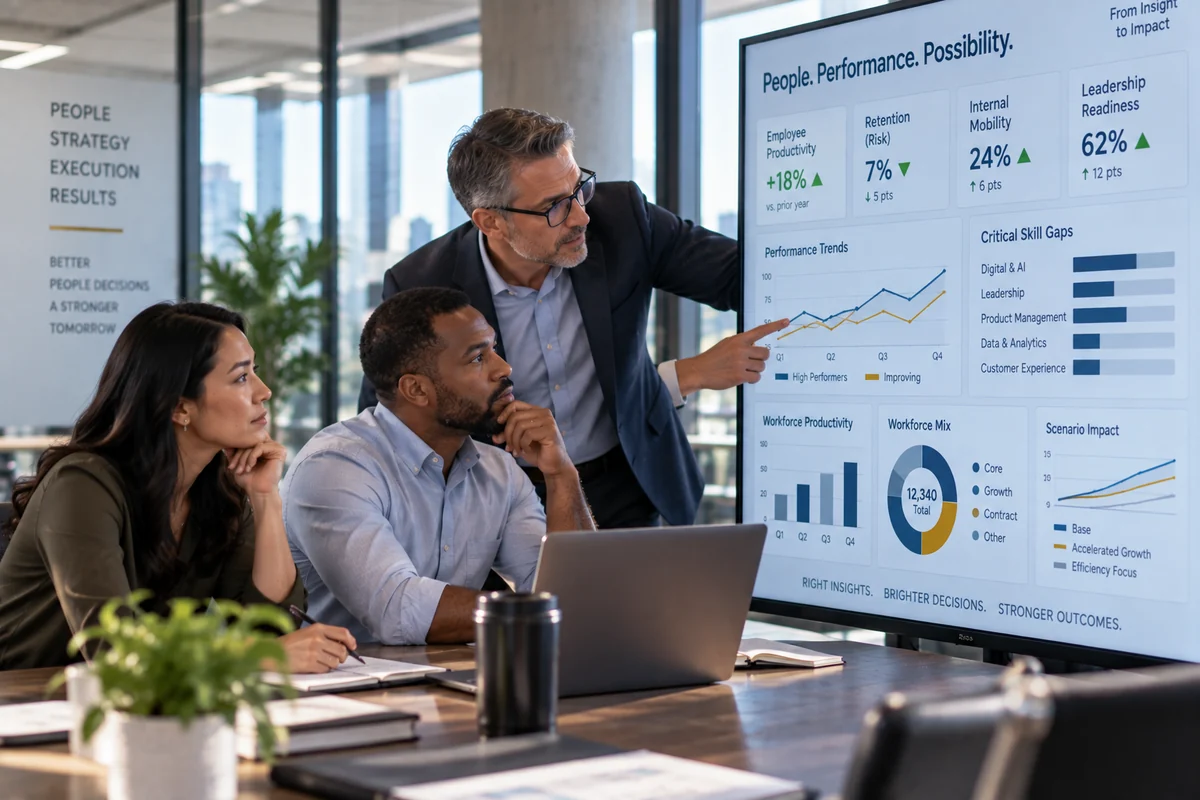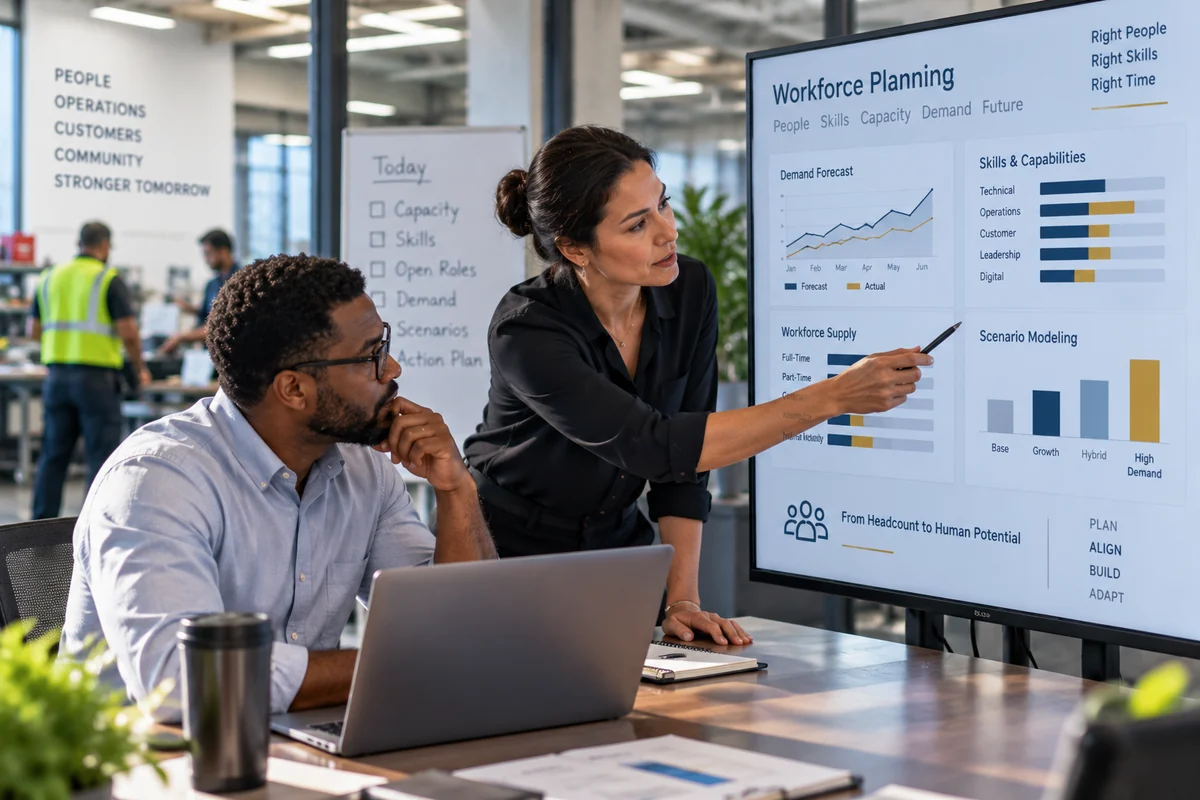

Few organizational capabilities have become more strategically important than workforce planning. Rapid advances in technology, demographic shifts, evolving labor markets, changing business models, and increasing competitive pressure have made the future workforce considerably more difficult to predict than at any other point in recent history. Executive teams are expected to anticipate changing skill requirements, prepare for workforce shortages, develop future leaders, manage labor costs, and ensure the organization possesses the talent necessary to execute its strategy under increasingly uncertain conditions. As a result, workforce planning has become a recurring topic in boardrooms, executive planning sessions, and strategic business reviews across nearly every industry.
Despite its growing importance, workforce planning is frequently misunderstood. Many organizations approach it primarily as an exercise in forecasting future staffing requirements. Sophisticated models estimate hiring demand, retirements, turnover, labor costs, and future employee requirements. These analyses can provide valuable operational insight, but they often converge on a narrower question than the business actually needs answered: How many people will we need?
Business leaders are attempting to determine whether the organization will possess the capability required to execute its strategy. They are concerned about whether critical skills will remain available as technology evolves, whether leadership pipelines are sufficiently prepared for future growth, whether automation will fundamentally change work requirements, whether key institutional knowledge is concentrated within too few individuals, and whether the organization can respond effectively to unexpected shifts in demand. These questions are not primarily about employee counts. They are questions about organizational capability, organizational capacity, workforce risk, and strategic readiness.
This distinction changes the purpose of workforce planning in a fundamental way. A workforce plan should not begin with the number of people the organization expects to employ. It should begin with the work the business must accomplish and the organizational capabilities required to accomplish it. Only then can leaders determine the capacity required, identify the workforce risks that could constrain execution, and choose the actions most likely to close the gap. Headcount becomes one possible outcome of the analysis rather than its primary objective.
Headcount is one resource available to build, deploy, and sustain capability, but it is not a measure of capability itself. An organization may forecast future workforce size accurately while still failing to anticipate emerging skill requirements, succession exposure, changing work design, productivity constraints, or opportunities to meet demand through automation, redeployment, partnerships, organizational redesign, or targeted development. Accurate staffing forecasts matter. They are simply insufficient as a definition of strategic workforce readiness.
Workforce planning is therefore better understood as a strategic organizational capability than as a staffing exercise. It connects business strategy to organizational capability, tests whether sufficient capacity can be created or accessed, identifies workforce risks before they become operational constraints, and informs the actions leaders must take today to prepare for future demand. When approached this way, workforce planning becomes a decision-support capability for executive teams because it helps determine not only how to staff a strategy, but whether the workforce assumptions embedded in that strategy are realistic.
Why Headcount Became the Default
Workforce planning did not become synonymous with headcount planning because organizations misunderstood strategy. It became synonymous with headcount planning because, for many years, employee growth was one of the most visible and measurable indicators of organizational expansion. As businesses entered new markets, launched additional products, expanded operations, or increased production capacity, workforce growth often followed. Hiring plans became closely associated with business plans, and forecasting future staffing requirements naturally became an important executive responsibility. Under relatively stable market conditions, estimating the number of employees required to support anticipated demand represented a practical and often effective approach to workforce planning.
Over time, however, workforce planning became increasingly operational rather than strategic. Organizations invested heavily in improving their ability to forecast vacancies, estimate turnover, project retirement eligibility, and calculate future hiring requirements. Human Resources developed increasingly sophisticated workforce models capable of predicting staffing demand with impressive precision. Finance teams incorporated labor costs into long-term financial planning. Business leaders refined staffing ratios, productivity assumptions, and recruiting forecasts to improve budgeting accuracy. Each of these capabilities added measurable value because they helped organizations anticipate future resource requirements more effectively.
The problem was not that these activities lacked value. It was that they gradually became the definition of workforce planning. As organizations became more proficient at forecasting employee counts, many unintentionally narrowed the conversation to hiring demand, turnover, vacancies, and labor cost. Those questions remain important, but they do not establish whether the organization will possess the capabilities required to compete successfully in the future.
This distinction has become increasingly significant because the nature of work itself has changed. Organizations no longer compete primarily through the size of their workforce. They compete through the quality of their capabilities. Digital transformation has altered the skills required in nearly every profession. Artificial intelligence is reshaping work that was once performed exclusively by people. Automation continues changing how organizations allocate labor across routine and complex activities. New business models emerge more quickly than traditional workforce planning cycles can often accommodate. In many industries, the greatest workforce challenge is no longer attracting enough employees; it is ensuring the organization possesses the right capabilities while continuously adapting those capabilities as business conditions evolve.
These changes expose an important limitation of headcount-based planning. Headcount describes workforce quantity. Strategic readiness depends on what the organization can reliably accomplish with the people, leadership, technology, structure, and operating conditions available to it. Two organizations with identical workforce sizes may possess very different levels of capability, capacity, and resilience.
Another consequence of headcount-focused planning is that it encourages organizations to think about workforce decisions after strategic decisions have already been made. Business leaders determine growth objectives, operational priorities, and financial targets before asking Human Resources how many people will be required to support them. Workforce planning then becomes a downstream staffing exercise rather than an upstream strategic capability. The workforce plan answers the question, "How do we staff the strategy?" rather than the more valuable question, "Does our workforce possess the capability to execute the strategy we intend to pursue?" The distinction may appear subtle, yet it fundamentally changes the role workforce planning plays in executive decision making.
This is where workforce planning should begin: with future business demand. Only after leaders understand the work the organization must perform can they identify the capabilities required, evaluate whether enough capacity can be created or accessed, assess the risks that could prevent successful execution, and determine the actions necessary to prepare the organization for the future. Hiring becomes one strategic option among several rather than the starting point of the planning process.
This perspective reframes workforce planning from a resource allocation exercise into an organizational capability discipline. Instead of asking how many employees will be required, leaders begin asking what the organization must become capable of accomplishing. Headcount remains an important consideration because people continue to be one of every organization's most valuable assets. It simply ceases to be the primary objective. The objective becomes building an organization capable of executing its strategy regardless of how work, technology, labor markets, or competitive conditions continue to evolve.
Workforce Planning Begins With Business Strategy
One of the most common reasons workforce planning fails to influence strategic decision making is that it often begins too late in the planning process. Business strategy is developed, financial objectives are established, operating plans are approved, and growth targets are defined before workforce planning begins. Human Resources is then asked to determine how many employees will be required to support decisions that have already been made. While this sequence may produce an accurate hiring forecast, it limits workforce planning to a reactive staffing exercise rather than positioning it as a strategic capability that informs executive decision making.
This distinction matters because organizations do not execute strategy with positions on an organizational chart. They execute strategy through the capabilities of the people, leaders, systems, and organizational structures that perform the work. Every strategic objective carries implicit workforce assumptions. A digital transformation strategy assumes the organization possesses the technical capability to implement new technologies. An expansion into new markets assumes leaders with the experience to build new operations, develop customer relationships, and manage increased organizational complexity. A productivity initiative assumes employees possess the knowledge, tools, and decision authority necessary to improve execution. These assumptions are rarely stated explicitly, yet they determine whether strategic ambitions can realistically be achieved.
Effective workforce planning therefore begins by asking a fundamentally different question than most organizations ask today. Instead of asking, "How many people will we need?", executive teams should first ask, "What work must the organization be capable of performing to execute its strategy?" This shift changes the conversation immediately. The focus moves away from staffing requirements and toward organizational capability. Leaders begin examining the future work itself before deciding how that work should be accomplished or who should perform it.
Once future work is understood, workforce planning becomes considerably more strategic. Rather than forecasting positions, leaders identify the capabilities required to perform that work successfully. Some capabilities already exist within the organization and may simply require redeployment. Others must be strengthened through learning and development, succession planning, leadership development, or targeted recruitment. Certain capabilities may be acquired through strategic partnerships, while others may emerge through automation or redesigned business processes. Hiring remains an important option, but it becomes one of several possible workforce decisions rather than the default response to every projected increase in demand.
Capability and capacity answer different questions and should not be treated as interchangeable. Capability describes what the organization is able to do: the knowledge, skills, leadership, systems, technology, and organizational conditions required to perform strategically important work. Capacity describes how much of that work the organization can realistically deliver, at the required level of quality and speed, within the constraints of time, workload, resources, technology, and organizational design. An organization may possess the right capability but insufficient capacity to meet demand, or ample capacity in work that no longer matters strategically. Workforce planning must test both.
Risk represents the next logical consideration. Every strategy depends upon assumptions regarding workforce availability, capability, and continuity. Critical expertise may reside within only a handful of employees approaching retirement. Emerging technologies may render existing skills less valuable while increasing demand for capabilities the organization has not yet developed. Labor market conditions may make recruiting essential talent increasingly difficult. Key leadership positions may lack viable successors. These risks are not independent workforce issues; they are strategic business risks because they directly influence the organization's ability to execute its objectives. Workforce planning should therefore identify these vulnerabilities long before they disrupt business performance.
Only after leaders understand future business demand, required capabilities, available capacity, and workforce risks should they determine the actions necessary to prepare the organization. Those actions may include hiring additional employees, but they may just as easily involve reskilling the existing workforce, redesigning roles, investing in automation, simplifying organizational structures, strengthening succession pipelines, adjusting operating models, or reallocating talent to higher-value work. The objective is not to increase headcount. The objective is to strengthen the organization's ability to execute its strategy with the resources available.
A useful workforce-planning sequence therefore begins with business strategy and progresses through a series of increasingly focused organizational questions. Each stage informs the next so that workforce decisions remain connected to the outcomes the business is attempting to achieve. By the time leaders reach decisions about hiring, development, automation, partnerships, redeployment, or organizational redesign, those choices should be grounded in a clear understanding of what the business requires and what the organization can realistically provide.
This perspective transforms workforce planning from an annual planning activity into an ongoing strategic capability. As business priorities evolve, so do capability requirements. As organizational capabilities mature, workforce risks change. As technology reshapes work, capacity assumptions must be reconsidered. Workforce planning therefore becomes a continuous cycle of organizational learning rather than a periodic exercise in estimating future headcount. The organizations that consistently outperform their competitors are rarely those with the most accurate hiring forecasts. They are the organizations that most effectively align workforce capability with business strategy while continuously adapting that alignment as conditions change.
This connection should also work in reverse. Workforce planning should not merely accept the strategy and calculate the workforce required to support it. If the organization cannot build, acquire, access, or redeploy a critical capability within the required time, cost, or risk tolerance, that evidence should inform the strategy itself. Leaders may need to change the pace of growth, sequence an initiative differently, redesign the operating model, narrow a strategic ambition, or choose a different path to value. In that sense, mature workforce planning does more than staff strategy. It tests whether the workforce assumptions inside the strategy are feasible before those assumptions become execution failures.
The Four Questions Every Workforce Plan Should Answer
Organizations often evaluate the quality of a workforce plan by the sophistication of its forecasts. Advanced analytics, labor-market data, turnover projections, retirement estimates, hiring scenarios, and predictive models can improve planning accuracy. Yet even sophisticated forecasting cannot compensate for answering the wrong question. A workforce plan should be evaluated by whether it equips leaders to make better decisions about future organizational readiness, not simply by how precisely it predicts future headcount.
Every effective workforce plan should answer four fundamental questions. Together, they move workforce planning beyond staffing forecasts and toward organizational readiness by connecting business strategy to capability, capacity, risk, and action.
1. What capabilities will the business require?
Every workforce decision should begin with the future state of the business rather than the current state of the workforce. Organizations frequently assess existing roles before clearly understanding the work those roles must perform in the future. As markets evolve, technologies mature, customer expectations shift, and business strategies change, the capabilities required for success also change. Some capabilities become increasingly valuable while others gradually lose strategic importance.
Effective workforce planning therefore begins by identifying the capabilities necessary to execute the organization's future strategy. These may include technical expertise, leadership, decision capability, digital fluency, customer knowledge, innovation, change capacity, operating disciplines, or other combinations of people and organizational conditions required to perform important work reliably. The purpose is not to create an exhaustive skills inventory. It is to identify the capabilities whose presence or absence will materially affect strategic execution.
2. Will the organization have sufficient capacity to deliver the work?
Capability alone does not guarantee execution. An organization may possess exceptionally talented employees yet still struggle because workload exceeds available capacity, work is poorly designed, decision making is unnecessarily complex, or resources are distributed inefficiently. Capacity therefore reflects much more than the number of employees available. It reflects the organization's practical ability to perform the work required to achieve its objectives.
Evaluating capacity requires leaders to examine how work actually flows through the organization. Where are bottlenecks developing? Which functions consistently operate beyond sustainable workload levels? Which activities create little strategic value while consuming significant organizational effort? Could technology, automation, improved processes, or redesigned operating models increase capacity without increasing headcount? These questions recognize that organizations often possess greater capacity than they realize once unnecessary complexity and inefficient work design are addressed.
3. What workforce risks could prevent successful execution?
Every strategy carries workforce assumptions, whether explicitly acknowledged or not. Critical expertise may reside within only a small number of employees. Leadership succession may be insufficient for anticipated growth. Emerging technologies may rapidly increase demand for capabilities the organization has not yet developed. Labor market conditions may make recruiting strategically important talent increasingly difficult. High turnover within key functions may threaten operational continuity, while changing demographics may create long-term knowledge transfer challenges.
Workforce planning should surface these risks before they become operational constraints. Rather than reacting to talent shortages, leadership vacancies, or capability gaps after business performance begins to suffer, organizations should continuously evaluate where future workforce vulnerabilities are likely to emerge. In this sense, workforce planning functions as an early warning system that enables leaders to reduce strategic risk before it affects execution.
4. What actions should leadership take today?
Only after understanding future capability requirements, organizational capacity, and workforce risks should leaders determine how the workforce must evolve. Hiring may represent the appropriate response in some situations, but it is rarely the only option available. Organizations may strengthen capability through targeted development, reskilling initiatives, succession planning, internal mobility, automation, process improvement, organizational redesign, strategic partnerships, or redeployment of existing talent. Each action carries different costs, risks, implementation timelines, and long-term organizational implications.
This broader perspective fundamentally changes workforce planning. Instead of producing a hiring plan, organizations develop a workforce strategy. Leadership gains a portfolio of coordinated actions designed to strengthen organizational capability while balancing cost, capacity, resilience, and long-term strategic objectives. Hiring becomes one strategic investment among many rather than the primary measure of workforce planning success.
Taken together, these four questions create a planning discipline that extends well beyond Human Resources. They require active participation from executive leadership, finance, operations, business unit leaders, and organizational development because the answers influence virtually every aspect of organizational performance. Workforce planning becomes a strategic management capability rather than an annual workforce exercise.
More importantly, these questions encourage leaders to think differently about the purpose of workforce planning itself. The objective is not to predict one future workforce with perfect precision. It is to ensure the organization can create enough capability, capacity, resilience, and adaptability across the plausible conditions the strategy may encounter. Scenario thinking becomes important because uncertainty does not eliminate the need for preparation; it changes what leaders should prepare for.
What Great Organizations Do Differently
Organizations that plan their workforces well do not necessarily possess greater certainty about the future. They face the same economic volatility, technological disruption, labor-market shifts, demographic changes, and competitive pressure as others. The difference is that they prepare more intentionally for uncertainty by connecting strategic choices to the capabilities and capacity those choices will require.
This distinction fundamentally changes the role of workforce planning. Rather than attempting to predict exactly how many people the organization will employ years from now, high-performing organizations focus on building the organizational capability and adaptability required to succeed regardless of how conditions evolve. They recognize that long-term workforce forecasts will inevitably become less accurate as uncertainty increases, but they also understand that uncertainty does not eliminate the need for preparation. Instead, it changes what leaders should prepare for.
First, workforce planning is inseparable from business strategy. Strategic planning discussions include explicit consideration of organizational capability because every major strategic choice carries workforce assumptions. Market expansion, acquisitions, digital transformation, product innovation, productivity initiatives, and customer-experience strategies all depend on combinations of leadership capability, expertise, capacity, and workforce resilience. Rather than asking Human Resources to support a completed strategy, leaders develop business and workforce choices together.
Second, workforce investments are treated as a portfolio of strategic options rather than a default hiring response. Leaders examine whether capability should be developed internally, acquired externally, accessed through partners, enabled through technology, created through redesign, or redeployed from elsewhere. Hiring remains important, but it competes with other pathways to the same strategic outcome.
Third, workforce risks are treated as business risks because each can constrain strategic execution. Critical expertise concentrated in a few people, weak succession depth, sustained turnover in pivotal roles, or scarce labor-market capability can alter the feasibility, timing, cost, or risk of a strategy. Evaluating these exposures together gives leaders a more complete view of readiness than monitoring them as separate HR metrics.
Finally, success is defined by readiness and decision quality rather than forecast accuracy alone. Leaders examine whether critical capabilities are strengthening, whether capacity is sufficient for expected demand, whether important risks are being reduced early enough to preserve strategic options, and whether the workforce can adapt as assumptions change. Forecast accuracy still matters, especially for budgeting and near-term operating decisions, but it is not the ultimate measure of strategic workforce planning.
This perspective also creates a more dynamic planning discipline. Workforce plans should be revisited as strategic assumptions, technologies, markets, and capability requirements change. The goal is not constant replanning for its own sake, but maintaining enough visibility to adjust before a capability or capacity gap becomes an operational constraint.
The objective is therefore not to predict the future workforce with perfect accuracy. It is to increase the organization's readiness across plausible futures and preserve options as conditions change. That adaptability allows leaders to respond without continually rebuilding the workforce from the ground up.
This is where workforce planning and Workforce Intelligence intersect. Traditional planning can become preoccupied with predicting the workforce the organization will have. Workforce Intelligence helps leaders interpret business and workforce evidence well enough to intentionally shape the workforce and organizational capability the strategy will require. The difference is not simply analytical; it is whether information changes strategic choices while there is still time to act.
Workforce planning is often presented as a forecasting discipline. Organizations project hiring demand, estimate workforce growth, calculate labor costs, and model future staffing scenarios with increasing analytical sophistication. These activities undoubtedly improve planning accuracy, but they also create an important risk. Leaders can become highly proficient at predicting workforce numbers while remaining uncertain whether the organization is actually becoming more capable of executing its strategy.
Effective workforce planning requires a different set of executive questions. Rather than focusing exclusively on the size of the future workforce, leaders should continually evaluate whether the organization is building the capability, capacity, resilience, and adaptability necessary to achieve its long-term objectives. The following questions are designed to shift workforce planning from an operational forecasting exercise toward a strategic leadership capability.
1. Does our workforce strategy begin with business strategy, or with today's organizational chart?
Many workforce planning initiatives begin by analyzing the current workforce. Leaders review existing positions, vacancy rates, turnover, retirement eligibility, and projected staffing needs before asking what capabilities the business will actually require in the future. While understanding the current workforce is important, beginning there can unintentionally anchor planning to today's organizational structure rather than tomorrow's strategic requirements.
Executive teams should instead begin by examining where the business is going. What products, services, technologies, markets, and operating models will define success over the next three to five years? What work will the organization need to perform that it cannot perform today? Only after answering these questions should leaders determine how the workforce must evolve. Strategy should define workforce requirements, not the other way around.
2. Are we measuring headcount, or organizational capability?
Headcount is one of the easiest workforce measures to report, but it is one of the least informative indicators of strategic readiness. Knowing how many employees the organization has says little about whether it possesses the expertise, leadership, adaptability, and capacity required to execute its strategy.
Executive teams should regularly evaluate the capabilities that matter most to future success. Which capabilities differentiate the organization competitively? Which are becoming more critical as technology, customer expectations, and business models evolve? Which capabilities are becoming obsolete? Workforce planning becomes considerably more valuable when leaders monitor the evolution of organizational capability rather than simply the growth or reduction of employee numbers.
3. Where are our greatest workforce risks, and how would they affect execution?
Not every workforce risk deserves equal attention. Some positions are difficult to recruit. Others are difficult to replace because they contain years of institutional knowledge or highly specialized expertise. Certain leadership roles may have limited succession depth, while emerging technologies may rapidly create capability gaps across entire functions.
Executive teams should ask which workforce risks would most directly threaten strategic execution if left unaddressed. This perspective encourages leaders to prioritize investments where they will have the greatest organizational impact rather than distributing resources evenly across every workforce issue. Workforce planning becomes a strategic risk management capability when it identifies vulnerabilities before they constrain business performance.
4. Are we treating hiring as the solution, or as one of several strategic options?
Organizations often respond to workforce challenges by asking how many additional employees they should recruit. Hiring is certainly an important workforce strategy, but it is rarely the only one. Development, internal mobility, succession planning, automation, organizational redesign, process improvement, strategic partnerships, and workforce redeployment may strengthen organizational capability more effectively than expanding headcount.
Executive teams should evaluate the full portfolio of workforce actions available before deciding how additional capability should be created. Doing so broadens workforce planning from a staffing conversation into a strategic resource allocation discussion, allowing leadership to consider multiple pathways toward achieving the same business outcome.
5. If our business strategy changed tomorrow, how quickly could our workforce adapt?
Perhaps the most revealing measure of workforce planning is not the accuracy of the forecast but the adaptability of the organization. Markets evolve. Technologies advance. Customer expectations change. Competitive pressures shift unexpectedly. Organizations that depend upon static workforce plans often struggle because their assumptions become outdated faster than their planning cycles can respond.
Leaders should therefore ask how resilient their workforce truly is. Can employees acquire new capabilities quickly? Can talent move efficiently across functions? Are leadership pipelines prepared for unexpected growth or disruption? Can work be redesigned without significant operational disruption? These questions evaluate the organization's ability to adapt rather than its ability to predict, and adaptability has become one of the most important competitive advantages available to modern organizations.
These questions deliberately move workforce planning beyond staffing forecasts and toward organizational readiness. They encourage executive teams to evaluate the workforce not simply as a collection of positions to be filled, but as one of the organization's most important strategic assets. When workforce planning consistently informs decisions about capability, capacity, risk, and adaptation, it becomes an essential component of strategic execution rather than an annual planning exercise.
Ultimately, the quality of a workforce plan should not be evaluated only by how accurately it predicted next year's headcount. It should also be evaluated by whether it helped the organization build, access, and deploy the capability it needed before the business depended on it.
Workforce planning has traditionally been viewed as a forecasting discipline. Organizations estimate future staffing requirements, project workforce growth, anticipate retirements, and model hiring demand in an effort to ensure that sufficient people are available to support future business needs. These activities remain important because organizations cannot execute their strategies without understanding the workforce resources they are likely to require. Accurate forecasting improves budgeting, strengthens operational planning, and reduces many of the risks associated with unexpected workforce shortages.
The limitations of workforce planning emerge when forecasting becomes the objective rather than the starting point. Forecasting errors can absolutely create cost, capacity shortages, and execution risk. The deeper limitation appears when leaders assume that forecast accuracy is sufficient evidence of workforce readiness. An organization may estimate workforce size accurately and still misread the capabilities required by the strategy, underestimate the time needed to build them, overlook critical concentration or succession risks, or delay action until demand has already outpaced capacity.
This distinction fundamentally changes the purpose of workforce planning. Rather than asking leaders to predict the future workforce with greater precision, effective workforce planning helps organizations prepare for the future with greater confidence. It connects business strategy to organizational capability, evaluates whether sufficient capacity exists to execute that strategy, identifies workforce risks before they become operational constraints, and informs the actions necessary to strengthen organizational readiness over time. Hiring remains an important workforce decision, but it becomes one of several strategic options available to leadership rather than the defining measure of workforce planning success.
Viewing workforce planning through this broader lens also changes the role of Human Resources. Workforce planning is no longer an annual staffing exercise delegated to a single function. It becomes an enterprise-wide strategic capability requiring collaboration among executive leadership, finance, operations, business unit leaders, and Human Resources because every significant business decision carries workforce implications. Strategy influences workforce capability, workforce capability influences organizational performance, and organizational performance ultimately determines whether strategy succeeds. Workforce planning therefore becomes one of the mechanisms through which these relationships are intentionally managed rather than left to evolve by circumstance.
A mature workforce-planning capability does not treat workforce planning as a process for predicting how many people the organization will employ in the future. It treats planning as a way to determine whether the organization can execute the futures the business is considering. The plan should therefore improve adaptability, strengthen critical capability, surface workforce risk, and preserve strategic options as assumptions change.
The foundational question for workforce planning is not simply, "How many people will we need?" It is, "Will the organization possess the capability and capacity to execute its strategy, and what must leadership do now if the answer is uncertain?"
Supporting Research
- Bechet, T. P. (2008). Strategic staffing: A comprehensive system for effective workforce planning (2nd ed.). AMACOM.
- Cappelli, P. (2008). Talent on demand: Managing talent in an age of uncertainty. Harvard Business Press.
- Cappelli, P. (2008). Talent management for the twenty-first century. Harvard Business Review, 86(3), 74–81, 133.
- Gibson, A., & Oldroyd, N. (2024). Agile workforce planning. In M. B. Sokol & B. A. Tarulli (Eds.), Strategic workforce planning: Best practices and emerging directions (pp. 116–139). Oxford University Press.
- Goldberg, E. (2024). Scenario planning: The secret sauce to making strategic workforce planning agile. In M. B. Sokol & B. A. Tarulli (Eds.), Strategic workforce planning: Best practices and emerging directions (pp. 282–299). Oxford University Press.
- Sokol, M. B., & Tarulli, B. A. (Eds.). (2024). Strategic workforce planning: Best practices and emerging directions. Oxford University Press.
- Ward, D. L. (2024). Strategic workforce planning: How can our legacy frame the future? In M. B. Sokol & B. A. Tarulli (Eds.), Strategic workforce planning: Best practices and emerging directions (pp. 15–26). Oxford University Press.