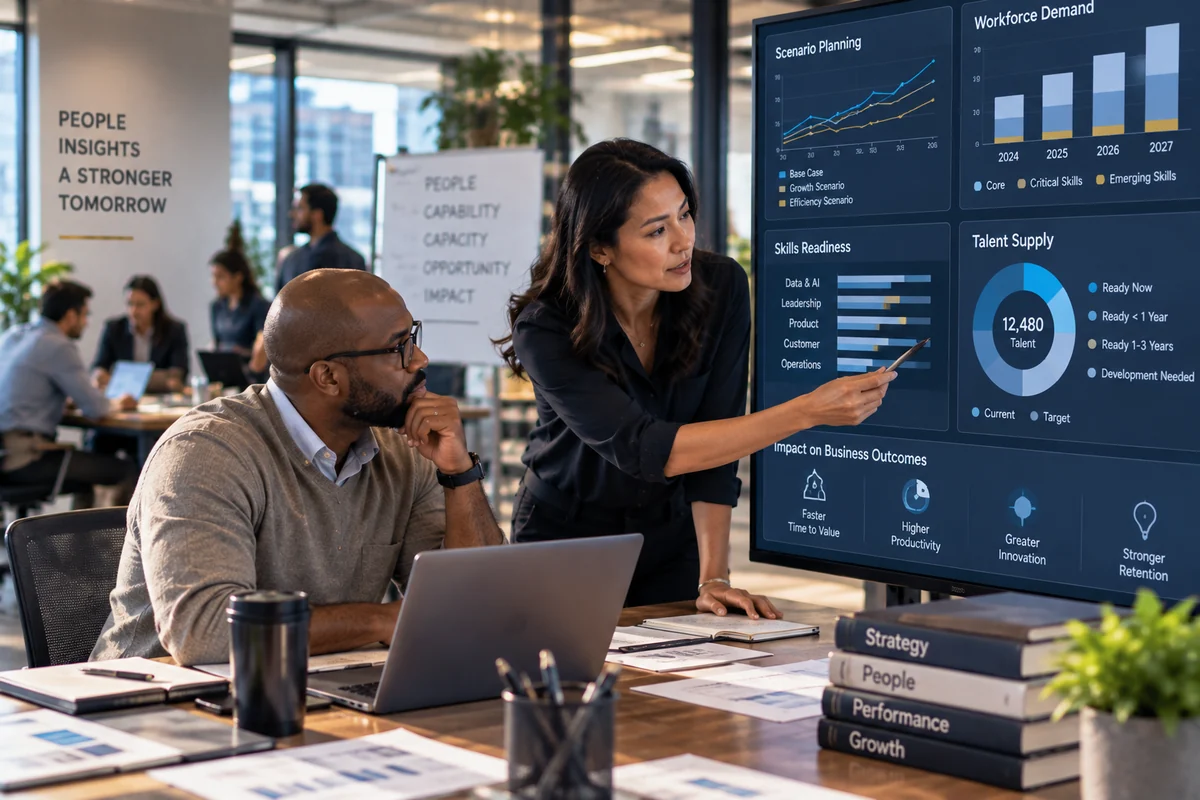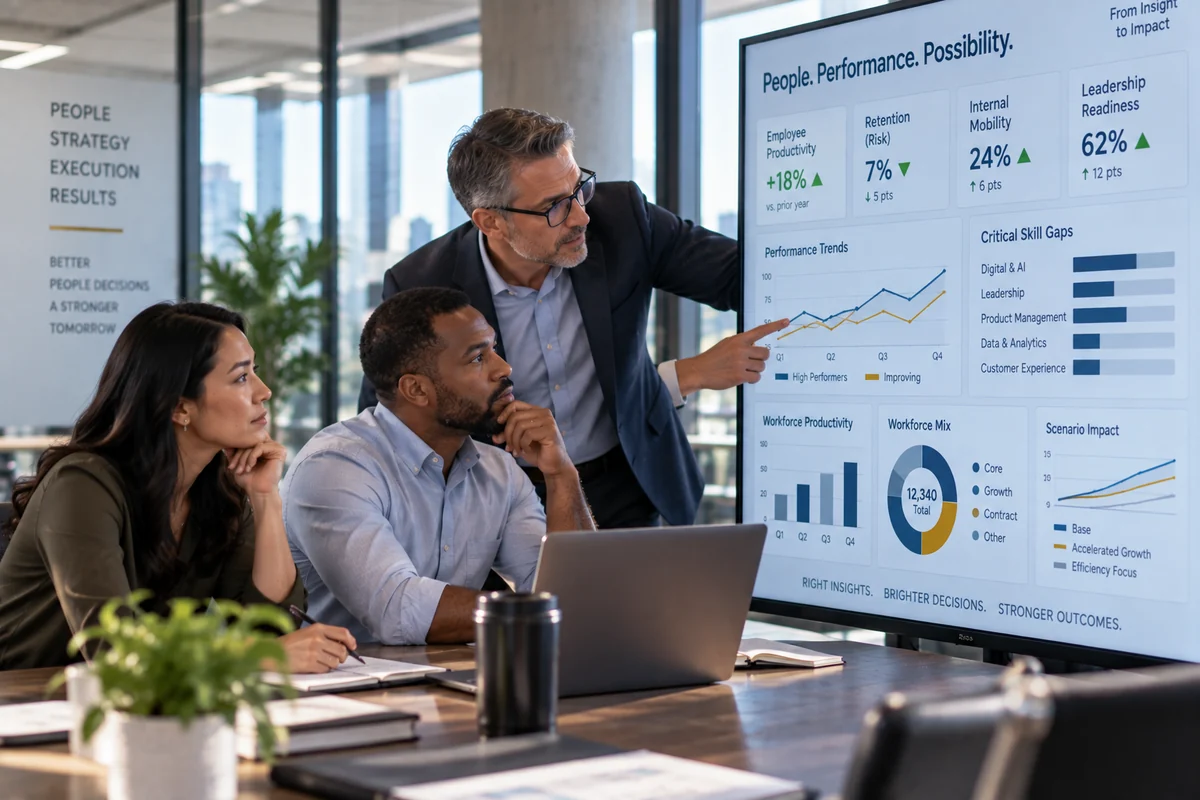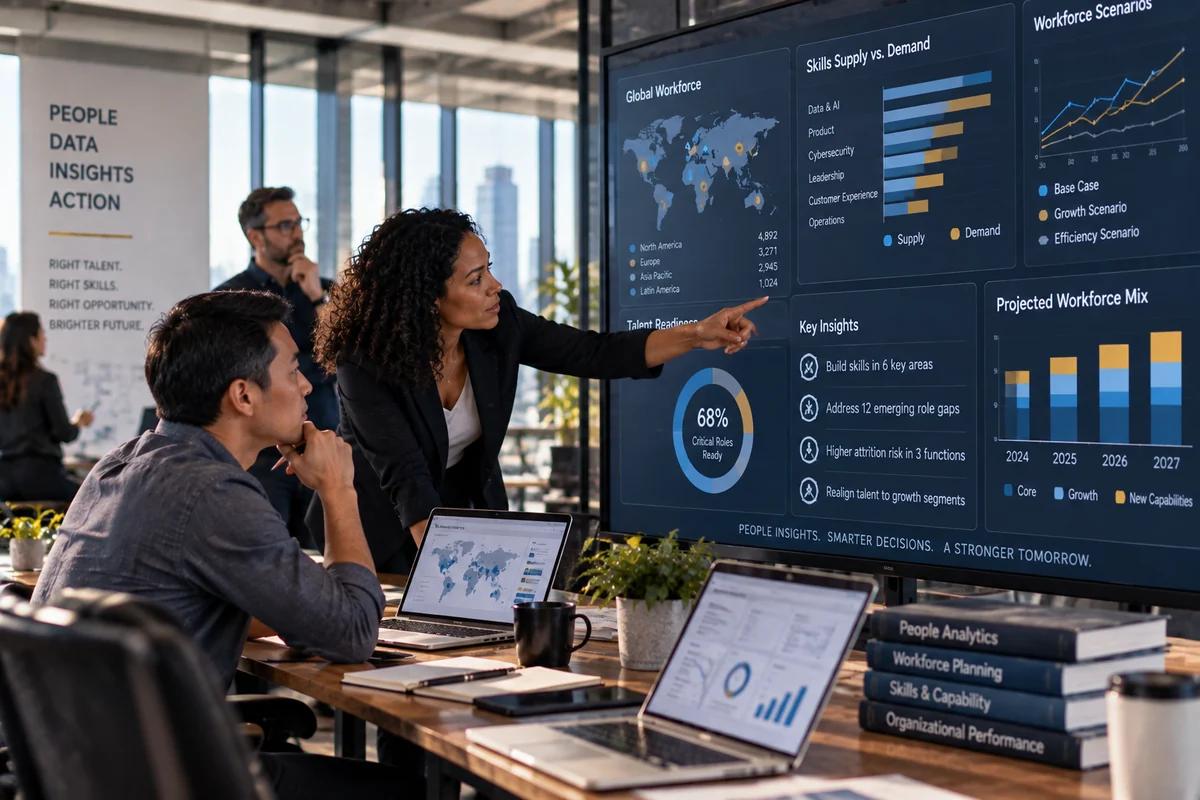

Organizations have never possessed more information about their workforce than they do today. Modern HR technologies provide executives with access to an extraordinary range of workforce metrics, including employee engagement, turnover, hiring, internal mobility, leadership readiness, succession strength, performance ratings, learning participation, compensation, workforce demographics, productivity, absenteeism, and countless other indicators. Interactive dashboards have replaced static reports, predictive models have supplemented historical trends, and advances in data visualization have made workforce information more accessible than ever before. From a technological perspective, organizations have made remarkable progress in their ability to collect, analyze, and distribute people data.
The abundance of information has not eliminated a more consequential problem: many executive teams still struggle to translate workforce data into clearer organizational decisions. Questions about capability, leadership readiness, restructuring, workforce investment, succession, automation, skill shortages, and strategic risk often remain difficult even when dashboards are sophisticated and data quality is strong.
The reason is not simply a shortage of analytics. Many organizations have designed workforce reporting around what their systems can measure rather than around what leaders need to decide. Dashboards can describe turnover, engagement, hiring, succession, mobility, performance, and learning with increasing precision, but visibility alone does not determine whether a capability gap warrants investment, whether a succession risk requires intervention, or whether the organization is prepared for a strategic shift. Information becomes strategically useful when it reduces uncertainty around a consequential decision.
That distinction changes the purpose of Workforce Intelligence. Its objective is not to measure people more extensively or to build more impressive dashboards. It is to connect important organizational questions to relevant evidence so leaders can make better decisions about the workforce and the organization it enables.
This perspective also changes how workforce analytics should be designed and evaluated. Instead of beginning with available data, organizations should begin with the decisions executives must make, identify the questions embedded in those decisions, and determine what evidence would materially improve the choice. Metrics then become inputs to decision making rather than the final product of the analytics function.
Success should therefore be measured by more than reporting accuracy, dashboard adoption, or analytical sophistication. Workforce Intelligence creates value when it improves the quality, timeliness, traceability, and organizational relevance of consequential decisions. Faster or more confident decisions are not inherently better decisions; the evidence must help leaders understand what matters, why it matters, what remains uncertain, and which choices are supported by the available information.
Workforce Intelligence is best understood as a decision-support capability. It connects organizational questions to meaningful evidence, integrates workforce information in context, and helps leadership move from observation to informed action under conditions of uncertainty.
The practical shift is simple but significant: the goal is not to build better dashboards as an end in themselves. The goal is to build an organization that can consistently turn workforce evidence into better organizational decisions.
Why Organizations Keep Building Better Dashboards
The rapid growth of people analytics has transformed the way organizations understand their workforce. What was once limited to static reports and historical summaries has evolved into sophisticated analytical capabilities capable of monitoring workforce trends in real time. Executive teams can now examine turnover patterns across business units, monitor engagement scores by manager, analyze promotion rates, evaluate succession pipelines, assess learning participation, forecast retirement eligibility, and visualize workforce demographics with remarkable speed and precision. These advances have unquestionably improved organizational visibility and have given leaders access to information that would have been extraordinarily difficult to obtain only a decade ago.
As analytical capabilities expanded, organizations naturally measured more of what technology made visible. New metrics were added, visualizations became more sophisticated, and reporting grew increasingly comprehensive. Over time, analytical maturity could be mistaken for reporting breadth, even though a larger dashboard does not necessarily provide greater clarity about the decision under discussion.
This evolution is understandable. Data is tangible, dashboards can be refreshed and benchmarked, and metrics create a shared language for discussing workforce conditions. Producing another report is also easier than determining whether the existing evidence is relevant to the decision leaders actually face. The result can be an organization that becomes exceptionally proficient at reporting workforce activity while remaining uncertain about the choices that matter most.
This shift occurred for understandable reasons. Data is tangible. Dashboards can be built, shared, refreshed, and benchmarked. Metrics create the appearance of precision and objectivity, allowing leaders to observe organizational activity through a common set of measures. When executives ask for additional insight, the instinctive response is often to provide additional data because producing another report is considerably easier than determining whether the existing information actually supports the decision under discussion. Gradually, organizations become exceptionally proficient at reporting workforce activity while remaining uncertain whether that activity explains the strategic questions leadership is attempting to answer.
Consider a common executive discussion about employee turnover. A dashboard may accurately report that voluntary turnover increased from nine percent to twelve percent during the previous quarter. It may identify which business units experienced the greatest changes, which demographic groups were most affected, and how current turnover compares with historical averages or external benchmarks. Each of these measures is valuable because it describes what occurred. Yet executive leadership is rarely interested in turnover as an isolated statistic. Leaders are trying to determine whether the increase threatens organizational capability, whether critical expertise is being lost, whether the causes are systemic or localized, whether intervention is necessary, and what actions should be taken. The dashboard often answers the first question while leaving the more important decisions unresolved.
The same pattern appears across many workforce measures. Engagement surveys reveal employee sentiment but may not indicate which leadership decisions require immediate attention. Succession dashboards identify potential successors but do not necessarily explain whether future organizational capability is sufficient to support strategic growth. Learning metrics report participation rates but provide limited evidence regarding whether capability has meaningfully improved. Recruitment dashboards measure hiring activity while offering little insight into whether the organization is acquiring the capabilities required for future competitiveness. In each case, the organization possesses valuable information. The challenge is that the information remains disconnected from the decisions executives must ultimately make.
The underlying design problem is sequence. Many analytics efforts begin by identifying what information is available, determining which measures can be reported consistently, and organizing those measures into executive dashboards. That sequence naturally centers the analytics function on workforce activity because activity is what most systems record most reliably. A decision-centered approach reverses the sequence by first asking what leadership decision the information is intended to improve.
Once the decision is defined, leaders can identify the questions that must be answered and the evidence needed to answer them. Workforce measures then become supporting evidence rather than the primary product. This does not diminish the value of reporting. Reporting can describe current conditions, reveal patterns, support diagnosis, and inform forecasts. The more important distinction is whether analytics remains information-centered or becomes decision-centered.
Reporting and intelligence are therefore not separated simply by whether one looks backward and the other looks forward. Both can use historical, current, predictive, and scenario-based information. The distinction is that reporting primarily organizes information, while Workforce Intelligence organizes relevant evidence around a decision that leadership must make.
When Data Becomes Evidence
One of the most persistent misconceptions surrounding workforce analytics is that more data naturally leads to better decisions. At first glance, this assumption appears reasonable. Better information should reduce uncertainty, reveal organizational trends, and enable leaders to make more informed choices. Advances in analytics technology have reinforced this belief by making it possible to collect, process, and visualize workforce information at an unprecedented scale. If organizations can measure more aspects of the workforce with greater precision, it seems logical that decision quality should improve accordingly.
More information can improve a decision, but only when the information is relevant to the question, credible enough to rely on, and interpreted in context. Without those conditions, additional data may increase visibility without reducing the uncertainty that matters.
Executive teams can therefore review increasingly sophisticated dashboards and still debate the same workforce questions. The issue may not be inaccurate data. It may be that the organization has accumulated information without establishing how that information should influence a specific decision.
A useful distinction is to separate data, evidence, insight, and decision. Data records observations, measurements, or reported facts. Evidence is data that is relevant to a defined decision question and credible enough to inform it. Insight is the interpretation produced when relevant evidence is examined in context and connected to the organizational conditions surrounding the issue. A decision is the leadership choice made after considering that insight alongside strategy, constraints, risk, alternatives, and professional judgment.
This sequence matters because a metric does not become strategically valuable merely by appearing on an executive dashboard. Turnover, engagement, performance, succession, compensation, learning, and mobility data may all be accurate while remaining only loosely connected to the decision leadership is attempting to make. The analytical task is to determine which evidence is relevant, what it means in combination with other evidence, what alternative explanations remain plausible, and what uncertainty the organization still has to manage.
Consider a decision about expanding leadership development investment. An organization may possess extensive data on manager engagement, promotion rates, performance outcomes, retention, learning participation, employee sentiment, and internal mobility. Those measures become decision-relevant only when leaders determine how they bear on the actual question: whether additional investment is likely to strengthen the leadership capability required by the business. The value lies not in the volume of data, but in whether the evidence changes the organization's understanding of the problem or the relative attractiveness of the available choices.
This distinction becomes even more important as predictive analytics and artificial intelligence expand analytical capability. Predictive models can identify patterns, estimate future outcomes, and surface relationships that leaders might otherwise miss. Artificial intelligence can make large amounts of information more accessible and accelerate analysis. These capabilities can strengthen the evidence available to a decision, but they do not determine whether the predicted outcome is strategically important, whether intervention is justified, or which competing objective should receive priority. Leadership remains responsible for the decision.
A decision-centered Workforce Intelligence process therefore works backward from the choice leadership must make. The organization defines the decision question, identifies the evidence required, determines which workforce measures are relevant, integrates that evidence in context, and develops an interpretation that leaders can evaluate. Recommendations should be traceable to the evidence supporting them, while uncertainty and alternative explanations remain visible rather than being hidden behind analytical precision.
This changes the role of analytics teams. Analysts become partners in organizational decision making rather than producers of recurring reports. Dashboards become tools for organizing relevant evidence rather than repositories for every available metric. Executive conversations shift from reviewing workforce activity toward understanding what the evidence implies for the decision at hand.
TQG describes this logic as a workforce decision evidence chain. It begins with the executive decision to be made, clarifies the decision question, identifies the required evidence and relevant workforce measures, integrates that evidence into insight, develops a leadership recommendation, and connects the recommendation to the intended organizational outcome. The sequence is not a scoring model or proprietary decision algorithm. It is a discipline for ensuring that workforce information remains connected to the leadership choice it is intended to improve.
What Great Organizations Do Differently
Organizations that make consistently strong workforce decisions are not necessarily distinguished by having more data than their peers. They may use similar HR systems, survey platforms, analytical tools, and operational measures. The difference is the discipline with which evidence is connected to consequential business questions.
They begin with decisions rather than dashboards. Executive teams identify the workforce and organizational choices that matter most to strategy, then design analysis around the evidence required to improve those choices. Questions about capability, leadership readiness, organizational capacity, succession risk, restructuring, automation, and workforce investment become the organizing logic for analytics rather than additional tabs on a reporting platform.
This also changes the relationship between analytics and the business. People analytics teams work with leaders to clarify the decision under consideration, surface assumptions, identify relevant evidence, and distinguish what the data supports from what remains uncertain. The value of the function lies not only in producing accurate information, but in helping leaders reason more effectively with that information.
Great organizations are equally disciplined about filtering evidence. Executive teams rarely need every available metric to make one decision. They need the measures that materially improve understanding of the issue, together with enough context to avoid false precision. The objective is not to simplify reality. It is to prevent irrelevant information from obscuring the evidence that matters.
They also integrate workforce information across organizational systems. Leadership capability is interpreted alongside succession and business demand. Workforce capacity is considered alongside work design, technology, and organizational structure. Employee sentiment is interpreted in the context of leadership behavior, workload, decision quality, and strategic alignment. Because workforce challenges often emerge from interactions among systems, decision-ready insight frequently requires evidence that crosses functional and analytical boundaries.
Finally, great organizations evaluate Workforce Intelligence by the decisions and learning it enables. Reporting accuracy, dashboard utilization, and analytical productivity remain important operating measures, but they do not establish strategic value. Leaders also ask whether the evidence changed a decision, exposed a risk early enough to act, clarified competing explanations, improved the allocation of resources, or generated learning that strengthened subsequent decisions.
This creates an adaptive capability. Each consequential workforce decision becomes an opportunity to test which indicators were useful, which assumptions held, what evidence was missing, and how the organization's analytical approach should change. Workforce Intelligence improves not because the dashboard becomes larger, but because the organization becomes more disciplined in connecting evidence to action.
The objective is therefore not simply to become more data-driven. It is to become more decision-driven while remaining evidence-informed. Data provides observations, evidence establishes relevance, insight creates meaning, and leadership applies judgment to choose among alternatives. Workforce Intelligence creates value when those elements work together.
Workforce analytics has matured significantly, but analytical maturity should not be confused with decision maturity. The executive test is whether workforce evidence is helping leaders make consequential choices with greater clarity, appropriate speed, and a more explicit understanding of uncertainty.
The following questions help distinguish a reporting capability from a decision-support capability.
1. What executive decisions should our Workforce Intelligence improve?
Every investment in workforce analytics should begin with a simple question: Which decisions are we trying to make better? Too often, organizations begin by identifying available data, selecting metrics, and designing dashboards before determining how those measures will influence leadership decisions. This approach almost guarantees that analytics will become descriptive rather than strategic.
Executive teams should identify the workforce decisions that have the greatest impact on organizational performance. These may include decisions about workforce investments, leadership development, organizational redesign, succession planning, automation, capability development, restructuring, or strategic hiring. Once those decisions are clearly defined, leaders can determine what evidence is actually required to support them. Beginning with the decision ensures that analytics remain connected to business value rather than becoming an exercise in reporting activity.
2. Which metrics genuinely reduce uncertainty, and which simply provide additional information?
Not every workforce measure contributes equally to a decision. Some metrics directly change how leaders understand a risk, option, or tradeoff. Others provide useful context without materially affecting the choice. When both appear together without hierarchy, important evidence can become difficult to distinguish from interesting information.
Executive teams should periodically test whether each executive-level measure serves a defined decision purpose. The objective is not to remove measurement for the sake of simplicity, but to ensure that scarce leadership attention is directed toward evidence that improves the quality of consequential choices.
3. Are we measuring workforce activity or organizational capability?
Many workforce dashboards emphasize operational indicators such as hiring volume, turnover rates, learning participation, engagement scores, or performance review completion. These measures provide useful operational visibility, but they do not necessarily indicate whether the organization is becoming more capable of executing its strategy.
Leaders should also ask whether Workforce Intelligence is helping them understand the organization's future readiness. Are strategically important capabilities strengthening? Are leadership pipelines improving? Is workforce capacity aligned with future business demand? Are emerging capability gaps being identified early enough to influence strategic decisions? These questions shift the conversation from monitoring activity to evaluating organizational capability, which is ultimately what executive teams are responsible for building.
4. Can we explain how our workforce evidence supports our recommendations?
Recommendations carry greater credibility when leaders understand the evidence behind them. Workforce Intelligence should not function as a "black box" in which dashboards produce conclusions without clearly explaining the organizational patterns that support those conclusions. Executive teams should be able to trace recommendations back to the relevant evidence, understand the assumptions involved, and evaluate alternative interpretations where appropriate.
This level of transparency strengthens executive confidence because it transforms analytics from a source of information into a source of reasoning. Leaders are more likely to act decisively when they understand not only what is being recommended, but also why the available evidence supports that recommendation.
5. If we removed every dashboard tomorrow, would leaders still know how to make good workforce decisions?
This question may be the most revealing because it distinguishes analytical capability from leadership capability.
Dashboards should improve executive judgment, not replace it. Organizations that rely exclusively on reports often become dependent upon the availability of data rather than developing the ability to interpret evidence, evaluate competing priorities, and make sound organizational decisions under conditions of uncertainty. By contrast, organizations with mature Workforce Intelligence capabilities use analytics to strengthen leadership thinking. Executives understand the strategic questions that matter, recognize what evidence is required, and use workforce information as one component of disciplined decision making rather than as a substitute for judgment.
Ultimately, Workforce Intelligence succeeds when leaders understand the basis for their decisions more clearly, not simply when they feel more informed. Confidence is useful only when it is supported by relevant evidence, explicit assumptions, and a disciplined understanding of what remains uncertain.
These questions intentionally move the conversation beyond dashboards, reports, and metrics. They encourage executive teams to evaluate Workforce Intelligence according to the quality of the decisions it supports rather than the sophistication of the technology that produces it. In doing so, leaders begin measuring success not by how much information is available, but by how effectively that information is transformed into organizational action.
Organizations have invested heavily in workforce analytics, and that investment has created unprecedented visibility into hiring, engagement, performance, succession, turnover, learning, and other workforce conditions. Visibility matters because leaders cannot respond intelligently to conditions they cannot see. But visibility is not the same as Workforce Intelligence.
Workforce data creates strategic value when it becomes relevant evidence for a consequential decision. A large dashboard can increase awareness without changing what leadership should do, while a small set of well-selected measures can alter how leaders invest in capability, allocate resources, redesign work, develop future leaders, or respond to emerging risk.
The design principle is therefore straightforward: begin with the decision, not the dashboard. Define the organizational question, identify the evidence required to evaluate it, interpret that evidence in context, and make the reasoning connecting evidence to recommendation visible. Analytical sophistication should strengthen that chain rather than obscure it.
This is what elevates Workforce Intelligence beyond Human Resources reporting. Workforce decisions are business decisions because they shape the organization's ability to execute strategy, adapt to changing conditions, build future capability, and sustain performance. The analytical function creates its greatest value when it helps leaders understand not only what is happening in the workforce, but what the evidence means for the choices ahead.
The purpose of Workforce Intelligence is not to measure the workforce more extensively. It is to ensure that workforce evidence improves the quality of organizational decisions.
Supporting Research
- Aguinis, H. (2023). Performance management (6th ed.). Chicago Business Press.
- Boudreau, J. W., & Ramstad, P. M. (2007). Beyond HR: The new science of human capital. Harvard Business School Press.
- Cascio, W. F., & Boudreau, J. W. (2011). Investing in people: Financial impact of human resource initiatives (2nd ed.). Pearson.
- Davenport, T. H., Harris, J. G., & Morison, R. (2010). Analytics at work: Smarter decisions, better results. Harvard Business Review Press.
- Fitz-enz, J., & Mattox, J. (2014). Predictive analytics for human resources. Wiley.
- Marler, J. H., & Boudreau, J. W. (2017). An evidence-based review of HR analytics. The International Journal of Human Resource Management, 28(1), 3–26.
- Rasmussen, T., & Ulrich, D. (2015). Learning from practice: How HR analytics avoids being a management fad. Organizational Dynamics, 44(3), 236–242.
- Ulrich, D., Younger, J., Brockbank, W., & Ulrich, M. (2012). HR from the outside in. McGraw-Hill.
- van den Heuvel, S., & Bondarouk, T. (2017). The rise (and fall?) of HR analytics: A study into the future application, value, structure, and system support. Journal of Organizational Effectiveness: People and Performance, 4(2), 157–178.