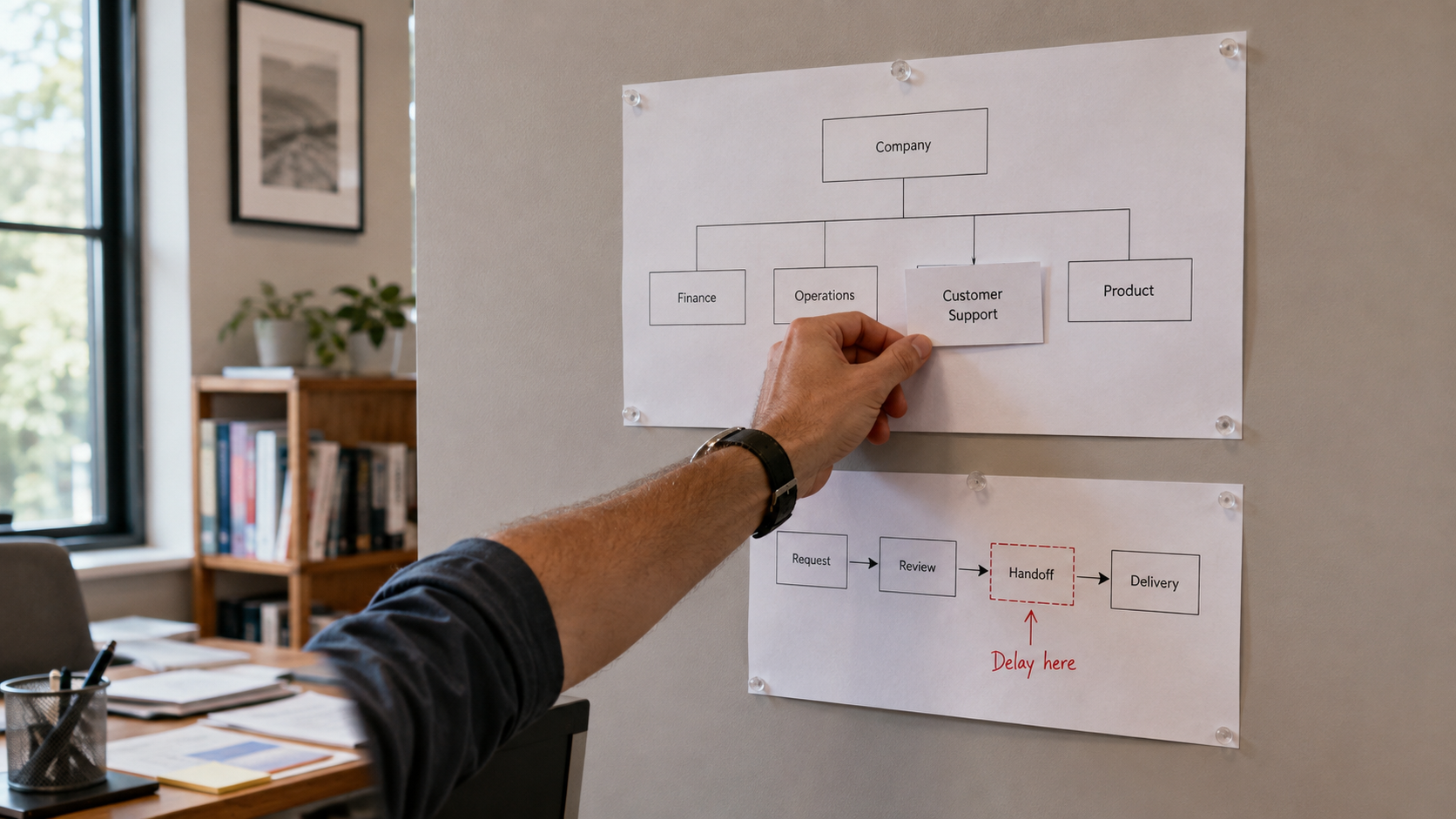

Few topics receive more attention in executive meetings than organizational structure. Leadership teams devote considerable time to debating whether the organization should become more centralized or decentralized, whether functions should be organized around products, customers, or geographies, whether management layers should be reduced, or whether reporting relationships should be redesigned altogether. Entire transformation initiatives are often justified by the belief that the organization's current structure has become the primary obstacle to better performance.
This assumption is understandable because organizational structure is one of the most visible aspects of an organization. Unlike leadership capability, governance, organizational culture, or decision quality, structure can be drawn on a single page. Reporting relationships can be changed. Business units can be combined or separated. New leadership roles can be created. Organizational charts provide the reassuring impression that the organization itself has become more organized.
For more than half a century, organizational design research has reinforced an important principle: organizational structure should support strategy rather than determine it. Chandler's pioneering work established the relationship between strategy and structure, while later research demonstrated that different organizational forms exist because organizations pursue different strategic objectives and operate under different environmental conditions. Subsequent research expanded this understanding by showing that organizational performance depends not on selecting a universally superior structure, but on achieving alignment among strategy, work, people, processes, and organizational systems.
Taken together, this body of research leads to an important conclusion. There is no such thing as a universally superior organizational structure. A functional organization strengthens different capabilities than a divisional organization. Matrix organizations solve different coordination challenges than regional structures. Centralized organizations create different operating conditions than decentralized ones. Each design offers meaningful advantages while introducing corresponding constraints because each was created to solve a different organizational problem.
Yet despite decades of research supporting this conclusion, executive teams continue searching for the "right" organizational structure as though one model might finally eliminate the frustrations experienced under another. Slow decisions become evidence that the hierarchy is wrong. Cross-functional conflict becomes evidence that reporting relationships should change. Inconsistent execution becomes evidence that additional centralization is necessary. The organization chart becomes the visible target because it is the easiest part of the organization to change. The difficulty is that many of these frustrations do not originate in the structure itself. They originate in the operating conditions the structure was designed to create.
Every organizational design strengthens certain capabilities while making others more difficult to sustain. Greater specialization increases the need for integration. Greater local autonomy reduces enterprise consistency. Stronger governance often slows decision making. Faster decision making frequently requires accepting greater variation in execution. These are not design failures. They are the natural consequences of strategic choices embedded within the organization. This leads to a different executive question.
Perhaps the objective of organizational design is not to discover the perfect organizational structure. Perhaps the objective is to understand which organizational capabilities the business is intentionally optimizing, which tradeoffs those choices create, and whether those tradeoffs continue supporting the strategy the organization is trying to execute. That question changes the conversation.
Instead of asking which organizational structure is best, leaders begin asking whether the design they have created is producing the operating conditions their strategy actually requires. That shift in perspective forms the foundation of a different way of thinking about organizational design.
Every Organizational Structure Optimizes Different Organizational Capabilities
The conclusion that no organizational structure is universally superior raises a more important question. If every structure has advantages and disadvantages, how should leaders determine whether their current design is the right one?
Most organizational design discussions answer this question by comparing structural models. Functional organizations are described as strengthening specialization and operational consistency. Divisional organizations improve responsiveness by bringing together the resources required to serve a product, customer, or market. Matrix organizations improve coordination across multiple dimensions while increasing the complexity of decision making. Network organizations emphasize flexibility, while shared-service models improve efficiency through consolidation. These descriptions are accurate, but they only explain how organizations are structured. They do not fully explain why those structures exist in the first place.
Decades of organizational design research suggest that organizations adopt different structures because they are attempting to solve different strategic problems. Chandler demonstrated that organizational structure should support strategic direction. Lawrence and Lorsch showed that organizations continually balance differentiation with integration as their environments become more complex. Galbraith later argued that organizational design fundamentally determines an organization's ability to process information as uncertainty and interdependence increase. Together, these perspectives established one of the central principles of modern organizational design: there is no one best structure because there is no one best strategy.
Yet executive teams continue approaching organizational design as though they are choosing among competing organizational charts rather than making strategic decisions about the capabilities they need the organization to produce. That distinction changes everything.
Organizations do not compete because they have adopted a functional structure, a matrix, or a divisional model. They compete because they consistently produce capabilities that competitors struggle to replicate. Some organizations compete through operational efficiency and disciplined execution. Others compete through technical expertise, customer intimacy, innovation, speed to market, or the ability to integrate highly specialized knowledge across multiple functions. These strategic priorities require fundamentally different organizational capabilities, and those capabilities ultimately determine the operating conditions the organization must create. The organizational chart is therefore not the starting point of organizational design. It is the visible consequence of strategic choices that have already been made.
An organization that intends to compete through operational excellence will naturally design different governance, coordination mechanisms, decision authority, and reporting relationships than one whose competitive advantage depends upon rapid innovation or customer responsiveness. Neither organization is more modern. Neither is more sophisticated. Each is simply reinforcing a different set of strategic priorities through its design.
This is why benchmarking organizational structures often produces disappointing results. Leadership teams frequently study admired organizations hoping to identify the structural model responsible for their success. They ask whether successful companies organize around products, regions, customers, or functions. Those observations can certainly generate useful ideas, but they often overlook the more important question.
What organizational capabilities was that structure designed to produce?
Without answering that question first, organizations risk copying visible design decisions while ignoring the strategic conditions that made those decisions effective. A matrix organization may be indispensable for a global technology company whose competitive advantage depends upon integrating engineering, product management, regional markets, and customer insights. The same structure may introduce unnecessary coordination costs for an organization whose strategy depends upon standardized execution and operational discipline. Likewise, a highly centralized organization may strengthen consistency and risk management in one enterprise while preventing another from responding effectively to rapidly changing customer needs.
The lesson is not that one organizational structure is better than another. The lesson is that organizational structures should be evaluated according to the capabilities they are expected to produce rather than the reporting relationships they contain. That subtle shift transforms organizational design from an exercise in rearranging organizational charts into an exercise in designing organizational capability. It also reveals something that existing organizational design literature explains only indirectly.
If strategy determines the capabilities an organization must develop, and those capabilities determine the operating conditions required for success, then every structural decision is also a decision about which organizational capabilities deserve greater emphasis, and which constraints leadership is willing to accept in return. The organization is not simply choosing a structure. It is choosing a pattern of strategic tradeoffs. That realization leads to a different way of thinking about organizational design.
Organizational Tradeoff Architecture
Recognizing that organizational structures optimize different organizational capabilities naturally leads to another question. If every design decision strengthens certain capabilities while making others more difficult, where do those tradeoffs actually come from?
Traditional organizational design literature answers this question indirectly. It explains that different organizational structures distribute authority differently, coordinate work differently, process information differently, and balance specialization with integration in different ways. These explanations are accurate and remain fundamental to modern organizational design. What they do not fully explain is how those individual design decisions accumulate into the operating conditions executives experience every day.
Leadership teams rarely experience organizational design as isolated structural choices. They experience it through delayed decisions, duplicated work, competing priorities, inconsistent customer experiences, governance overload, excessive coordination, uneven accountability, or increasing organizational complexity. These conditions often appear unrelated because they emerge gradually over time, frequently across multiple organizational systems rather than from a single design decision. Yet they are connected. They are the operational consequences of the strategic choices embedded within the organization's design.
TQG refers to this underlying pattern as Organizational Tradeoff Architecture.
Organizational Tradeoff Architecture is the pattern of strategic tradeoffs embedded within an organization's design that shapes how the organization naturally behaves. It determines which capabilities become easier to develop, which become more difficult to sustain, where coordination becomes necessary, how authority is exercised, how information flows, and where leadership attention will inevitably be required.
The distinction is important because Organizational Tradeoff Architecture is not another organizational structure. It is not a new organizational model intended to replace functional, divisional, matrix, regional, or network organizations. Instead, it provides a way of understanding what every organizational structure is actually doing beneath the reporting relationships. Every organizational chart represents hundreds of strategic decisions. Some are deliberate. Others emerge gradually as the organization grows.
New products require additional coordination. Acquisitions preserve legacy operating models. Governance expands following operational failures. Decision authority shifts as leaders attempt to improve consistency or accelerate execution. Processes are added to reduce risk. Exceptions become permanent practices. Technology changes how information moves through the enterprise. Individually, these decisions appear reasonable.
Collectively, they reshape how the organization operates. This is why two organizations with remarkably similar organization charts often perform very differently. One organization may consistently make faster decisions despite operating within a complex global matrix. Another may struggle with slow approvals despite maintaining a relatively simple functional hierarchy. One organization may collaborate effectively across business units while another experiences constant conflict despite having nearly identical reporting relationships. The difference frequently lies beneath the organization chart. It lies within the strategic tradeoffs that have accumulated over time and the extent to which leadership intentionally understands and manages them. This perspective changes how executives should interpret organizational problems.
When coordination becomes difficult, the first question should not be whether reporting relationships need to change. When decision making slows, the first question should not be whether another management layer should be removed. When accountability appears inconsistent, the first question should not be whether another reorganization is necessary. Those questions begin with the visible organization.
High-performing organizations learn to begin somewhere else. They begin by asking whether the organization's tradeoff architecture is still aligned with the capabilities required to execute strategy. That subtle shift changes organizational design from a structural exercise into a strategic one. It also explains why organizations can spend years reorganizing without fundamentally improving performance. Reporting relationships may change repeatedly while the underlying tradeoff architecture remains largely untouched. Leaders experience the same organizational friction because the operating conditions producing that friction were never intentionally redesigned.
This realization leads to what may be the most important principle in organizational design. Every organizational chart is a record of strategic decisions made visible. An organization chart is often treated as a map of reporting relationships. It is much more than that. It is a visible record of how leadership has chosen to balance specialization with integration, enterprise consistency with local responsiveness, governance with speed, operational discipline with flexibility, and control with empowerment. Every box, reporting line, leadership role, and organizational boundary reflects countless strategic decisions about what the organization values most and which tradeoffs it is willing to accept in pursuit of those priorities.
Understanding the organization chart therefore requires understanding the strategic choices embedded within it. The chart itself is simply the visible expression of those decisions. Organizational Tradeoff Architecture makes the invisible visible.
High-Performing Organizations Design Tradeoffs Before They Design Structures
One of the unintended consequences of focusing primarily on organizational structure is that leadership teams often postpone the most important conversation until after they have already begun redesigning the organization. Reporting relationships are debated before strategic priorities are fully aligned. Management layers are discussed before organizational capabilities have been clearly defined. New organizational charts are drafted before leaders have agreed on the operating conditions necessary to execute the strategy successfully.
This sequence is understandable because organizational structures are visible, while the strategic choices that shape them are not. It is considerably easier to discuss where functions should report than to reach agreement about the capabilities the organization must consistently produce to achieve its strategic objectives.
High-performing organizations reverse that sequence. They begin by defining the capabilities required to execute their strategy. Only then do they determine the organizational conditions necessary to support those capabilities. Those operating conditions naturally reveal the strategic tradeoffs leadership must intentionally make. Organizational structure becomes the final expression of those decisions rather than the starting point of the conversation.
This progression may appear procedural, but it represents a fundamentally different philosophy of organizational design. Organizations do not create competitive advantage because they selected the "right" organizational structure. They create competitive advantage when the major organizational systems reinforce the capabilities their strategy requires. Structure is one of those systems, and it should be designed in concert with governance, decision authority, information flow, talent, and the way work is coordinated.
This perspective also explains why successful reorganizations often appear deceptively simple. Observers frequently attribute their success to the new reporting relationships, when the more significant work occurred long before the organization chart changed. Leadership aligned around strategic priorities. They reached agreement on the capabilities the business required. They clarified decision authority. They redesigned governance. They established how work should flow across the enterprise. By the time the organization chart was revised, most of the critical design decisions had already been made. The chart simply made those decisions visible.
Organizations that struggle with repeated reorganizations often follow the opposite pattern. Structural changes become the catalyst for strategic discussions rather than the result of them. New reporting relationships are expected to solve problems that actually originate in governance, decision authority, leadership capability, or operating processes. Because those underlying conditions remain largely unchanged, the organization experiences temporary improvement before many of the same frustrations gradually return. The structure changed, but the operating conditions did not.
This distinction highlights one of the most important responsibilities of executive leadership. Organizational design is not primarily an exercise in arranging reporting relationships. It is an exercise in deliberately designing the operating conditions through which people make decisions, coordinate work, share information, exercise authority, and execute strategy together. Viewed through this lens, the organization chart becomes a reflection of leadership choices rather than a solution in itself. It communicates what leadership has decided to optimize, where authority will reside, how work will be coordinated, and which organizational capabilities deserve the greatest emphasis.
The chart is therefore closer to the conclusion of organizational design than its beginning. That realization changes how leaders should approach a redesign. Rather than beginning with the question, "How should we reorganize?" leaders should begin with a more fundamental one: "What capabilities must this organization consistently produce, and what operating conditions will make those capabilities possible?" Structural choices should follow from that logic.
What Great Organizations Do Differently
One of the most persistent misconceptions in organizational design is that exceptional organizations possess fundamentally better structures than everyone else. The idea is appealing because it suggests that performance can be materially improved by finding a superior reporting model. In practice, high performance is more often associated with the fit among strategy, capabilities, operating conditions, and the broader organizational system than with any universally superior structural form.
Many high-performing organizations operate through functional structures. Others succeed with divisional organizations, regional business units, matrix organizations, or hybrid designs that continue evolving over time. Their organization charts often look remarkably similar to those of their competitors. What distinguishes them is rarely the visible structure itself. It is the discipline with which they continually align their organizational systems to the capabilities their strategy requires. This distinction is subtle but important.
High-performing organizations understand that organizational structure is only one component of a much larger operating system. Governance determines how decisions are made. Leadership establishes priorities and expectations. Decision authority determines where choices are made. Performance management reinforces desired behaviors. Talent systems influence organizational capability. Operating processes shape how work moves across the enterprise. Organizational structure provides the framework through which these systems interact, but it cannot compensate for weaknesses within them.
Consequently, mature organizations are less concerned with whether they have found the "right" structure than with whether their organizational systems remain aligned and continue reinforcing the capabilities the strategy requires. That evaluation becomes increasingly important as the organization evolves.
Growth changes coordination requirements. New technologies alter how information moves across the enterprise. Customer expectations redefine competitive advantage. Acquisitions introduce additional complexity. Regulatory environments reshape governance. Leadership teams change. Business strategies evolve. Each of these developments changes the capabilities the organization must strengthen in order to remain successful.
The question is no longer whether the existing organization chart remains familiar. The question is whether it continues creating the operating conditions necessary for future success. This is where Organizational Tradeoff Architecture becomes particularly valuable.
Rather than evaluating organizational design through reporting relationships alone, leadership can examine whether the strategic tradeoffs embedded within the organization continue supporting the business it is trying to become rather than the business it once was. That distinction helps explain why some organizations redesign successfully while others find themselves trapped in repeated cycles of restructuring.
Organizations that repeatedly reorganize often focus on the visible organization. Organizations that redesign successfully focus on the operating system beneath it. They recognize that reporting relationships are only one expression of organizational intent. Lasting improvements occur when governance, decision authority, leadership capability, organizational processes, performance systems, and organizational structure evolve together in support of a common strategic direction.
This integrated perspective also changes how leaders interpret organizational tension. Less mature organizations frequently assume that recurring friction indicates poor organizational design. Delayed decisions, cross-functional disagreement, governance challenges, competing priorities, or inconsistent execution become evidence that another structural redesign is necessary.
High-performing organizations reach a different conclusion. They first ask whether the tension reflects an intentional strategic tradeoff. If the organization has deliberately prioritized innovation, some increase in coordination may be expected. If enterprise consistency has become a strategic priority, additional governance may be appropriate. If customer responsiveness is essential, greater local autonomy may be justified despite introducing additional variation across the organization.
Not every source of organizational friction should be eliminated. Some should be managed because they represent the inevitable consequence of strengthening capabilities the strategy requires. The discipline lies in distinguishing between productive organizational tension and unnecessary organizational complexity.
Productive tension emerges because leadership has intentionally chosen competing priorities that must be continually balanced. Unnecessary complexity emerges when legacy structures, outdated governance, duplicated capabilities, or accumulated organizational decisions continue consuming leadership attention without creating corresponding strategic value. One strengthens organizational performance. The other quietly constrains it.
The responsibility of executive leadership is not to eliminate every organizational tension. It is to understand which tensions the organization has intentionally chosen, which have accumulated unintentionally over time, and whether both remain aligned with the strategy the organization intends to execute. Organizations rarely become more effective because they eliminate every tradeoff. They become more effective because they deliberately manage the tradeoffs that matter most.
Organizational design should not begin with an organization chart. It should begin with a deeper understanding of the organizational capabilities the business strategy requires and the tradeoffs leadership is prepared to manage in pursuit of those capabilities. Before approving a reorganization or redesigning reporting relationships, executive teams should challenge themselves with five questions.
1. What organizational capabilities must we consistently produce to execute our strategy successfully?
Every structural decision should reinforce capabilities that directly support the organization's strategic objectives. Without clearly defining those capabilities, organizational design becomes an exercise in rearranging reporting relationships rather than improving organizational performance.
2. Which strategic tradeoffs have we intentionally chosen, and which have accumulated over time without deliberate review?
Every organization operates through a unique pattern of tradeoffs. Some are conscious strategic decisions. Others emerge gradually through growth, acquisitions, governance changes, technology, or historical practices. Effective leaders understand the difference.
3. Are the challenges we attribute to organizational structure actually being created by other organizational systems?
Decision authority, governance, leadership capability, operating processes, incentives, and performance management frequently create symptoms that appear structural but originate elsewhere. Changing the organization chart rarely resolves problems created by these systems.
4. If we changed our organizational structure tomorrow, which operating conditions would actually improve?
Reporting relationships only matter to the extent that they change how decisions are made, how work is coordinated, how information flows, and how accountability is exercised. If those operating conditions remain unchanged, the redesign may produce very little organizational benefit.
5. Does our current organizational design reflect the strategy we are executing today, or the strategy we pursued several years ago?
Organizations evolve continuously. Markets change. Customer expectations shift. Technologies emerge. Competitive priorities change. Organizational design should evolve with equal discipline to ensure the operating system continues supporting the capabilities required for future success.
These questions are intentionally diagnostic rather than prescriptive. Their purpose is not to recommend a particular organizational structure. Their purpose is to ensure executive teams begin with the right conversation before concluding that structural change is the appropriate solution.
Organizational structure has always been one of the most visible expressions of leadership, but visibility has encouraged many organizations to assign it more influence than it actually possesses. Reporting relationships matter because they shape coordination, accountability, authority, and communication. They do not, however, operate independently of the broader organizational system.
The strongest organizations recognize that structure is the visible expression of deeper strategic decisions. Every organizational design strengthens certain capabilities while requiring leadership to manage corresponding tradeoffs. Those tradeoffs are neither flaws nor unintended consequences. They are the inevitable result of choosing what the organization intends to optimize.
The objective of organizational design is therefore not to discover a perfect organizational structure. It is to intentionally align organizational capabilities, operating conditions, and strategic tradeoffs so the structure supports the strategy rather than becoming a substitute for it.
Organizations do not become high performing because they eliminate every tradeoff. They become high performing because they deliberately choose, understand, and continuously manage the tradeoffs that matter most.
Supporting Research
- Burton, R. M., Obel, B., & Håkonsson, D. D. (2020). Organizational design: A step-by-step approach (4th ed.). Cambridge University Press.
- Chandler, A. D., Jr. (1962). Strategy and structure: Chapters in the history of the industrial enterprise. MIT Press.
- Galbraith, J. R. (1974). Organization design: An information processing view. Interfaces, 4(3), 28–36.
- Galbraith, J. R. (2014). Designing organizations: Strategy, structure, and process at the business unit and enterprise levels (3rd ed.). Jossey-Bass.
- Lawrence, P. R., & Lorsch, J. W. (1967). Organization and environment: Managing differentiation and integration. Harvard Business School Press.
- Mintzberg, H. (1983). Structure in fives: Designing effective organizations. Prentice-Hall.
- Nadler, D. A., & Tushman, M. L. (1997). Competing by design: The power of organizational architecture. Oxford University Press.
- Tushman, M. L., & Nadler, D. A. (1978). Information processing as an integrating concept in organizational design. Academy of Management Review, 3(3), 613–624.